Our Location
304 North Cardinal St.
Dorchester Center, MA 02124

304 North Cardinal St.
Dorchester Center, MA 02124

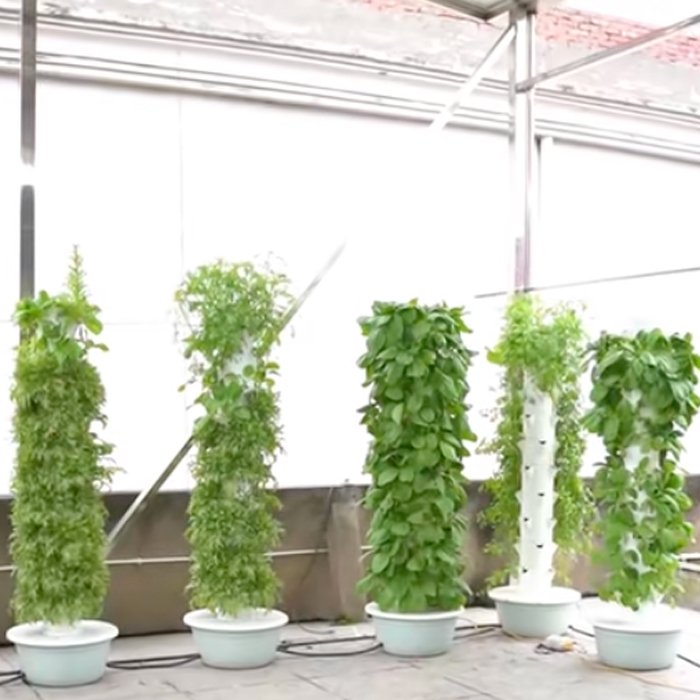
If you’ve seen photos of tall white columns covered in leafy greens and wondered “what is a hydroponic tower and how does it actually work?” — you’re in the right place. Hydroponic towers are one of the fastest-growing segments in commercial vertical farming, and for good reason: they pack dozens of plants into a tiny footprint, use 90% less water than soil, and can be operated by one person. This complete guide explains the system from the ground up.
A hydroponic tower is a vertical growing system — typically a hollow column made of food-grade PP or PVC — with planting holes arranged around its sides. Plants grow out of the holes, their roots suspended inside the column where they receive a continuous flow of nutrient-rich water. Because the tower grows upward instead of outward, a 1.5 square meter footprint can hold 40-50 plants, compared to roughly 8-10 plants in traditional soil beds of the same area.

The principle is simple: water + nutrients + light = growth, with no soil required. Here’s the cycle step by step:
Most towers use a timer to run the pump in cycles (e.g., 15 minutes on, 30 minutes off), which keeps roots moist while ensuring they get oxygen between cycles.
| Component | Function |
|---|---|
| Tower column | Structural body with planting holes; channels water from top to bottom |
| Planting cups / net pots | Hold the plant and growing medium in each hole |
| Growing medium | Clay pebbles or coco coir support the roots while water flows through |
| Water pump | Circulates nutrient solution from reservoir to tower top |
| Reservoir / base tank | Stores and recirculates the nutrient solution |
| Timer / controller | Automates pump cycles for consistent watering |
| Optional: LED lights | Supplemental or full artificial lighting for indoor/indoor greenhouse use |
From seedling to harvest, a typical tower crop cycle looks like this:
Because harvest is staggered by planting schedule, commercial growers pick crops every few days from the same tower — maximizing yield per square meter year-round.

Towers are ideal for shallow-rooted, fast-growing crops. The most profitable choices for commercial growers:


| System | Footprint Efficiency | Setup Complexity | Operating Cost | Best For |
|---|---|---|---|---|
| Hydroponic Tower | Excellent (vertical) | Low | Low | Leafy greens, herbs, strawberries |
| NFT Channels | Good (sloped trays) | High | Medium | Lettuce at scale, single-crop |
| DWC (Deep Water Culture) | Fair (flat beds) | Medium | Medium | Large fruiting plants |
| Vertical Racks + LED | Excellent (shelving) | High | High (lighting + HVAC) | Indoor-only, high-value crops |
For outdoor and greenhouse growers, towers offer the best balance of low startup cost, simple operation, and high space efficiency. They’re also the easiest system to expand incrementally.

SpaceTree manufactures commercial-grade hydroponic towers and exports directly to farms, greenhouses, and distributors worldwide. Whether you’re starting with your first 10 towers or planning a 500-tower facility, we’ll help you configure the right system for your space and crops.
Want the full picture? Read our Hydroponic Tower Cost Breakdown for pricing and ROI, or Hydroponic Tower Lighting Requirements to plan your light setup.
