Our Location
304 North Cardinal St.
Dorchester Center, MA 02124

304 North Cardinal St.
Dorchester Center, MA 02124

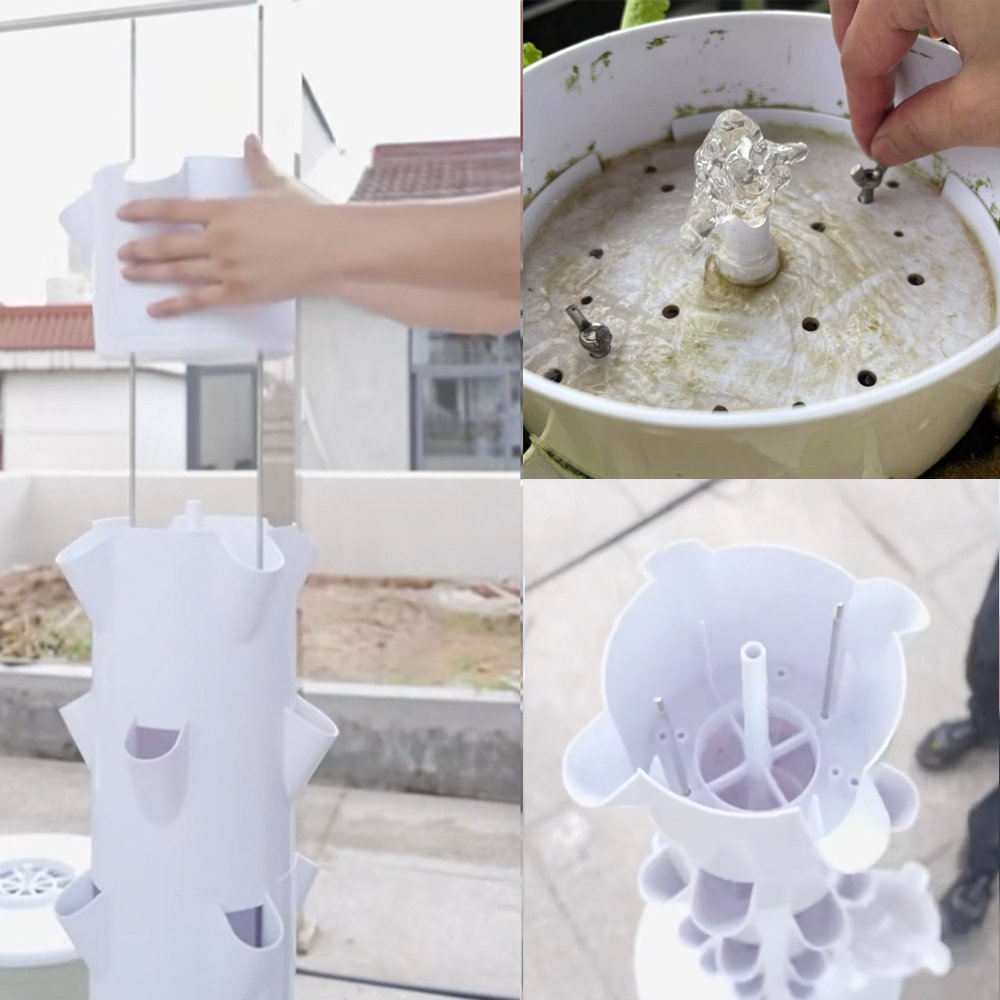
If you are shopping for a commercial hydroponic tower system, you have probably noticed a wide price gap. Some towers come with timers, pumps, and sensor ports. Others are bare-bones structures where you supply everything yourself. Which one should you buy?
The answer depends on your farm size, labor costs, technical skills, and growth stage. In this guide, we break down the real differences between manual and automated hydroponic towers across four key dimensions: upfront cost, labor requirements, yield consistency, and operational complexity. By the end, you will know exactly which system fits your operation.
Before comparing, let us define the two categories clearly.
A manual system includes the tower structure plus a basic submersible pump. The pump runs continuously or on a simple mechanical timer that you set by hand. You check pH and EC with handheld meters, adjust nutrients manually, and observe plant health with your own eyes. Most entry-level and mid-range towers on the market today fall into this category.
An automated system adds digital controllers, programmable irrigation schedules, remote monitoring, and often integrated dosing. Features may include:
Fully automated towers are less common but growing fast as sensor costs drop and cloud-based controllers become affordable for small and mid-size farms.
| Cost Factor | Manual System | Automated System |
|---|---|---|
| Base tower price (52-plant unit) | $150 – $400 | $400 – $1,200 |
| Pump & timer | $15 – $40 (included) | $80 – $250 (smart pump + controller) |
| pH/EC meters | $30 – $100 (one-time) | $200 – $800 (inline sensors + controller) |
| Auto-dosing equipment | $0 (manual dosing) | $300 – $1,500 per nutrient line |
| Monitoring & connectivity | $0 | $100 – $500 (IoT gateway + sensors) |
| Annual consumables | $50 – $120 (replacement sensors, calibration fluids) | $80 – $200 (sensor maintenance, calibration) |
| Year 1 total (per 10 towers) | $2,000 – $5,000 | $10,000 – $30,000 |
| Year 3 total (per 10 towers) | $2,300 – $5,600 | $10,500 – $31,500 |
The upfront premium for automation is 3x to 5x higher. However, the real question is whether that investment pays for itself in labor savings and yield improvements. Let us look at those numbers next.
Labor is the single largest operating expense for most indoor farms. Here is how the two systems compare on a per-tower, per-week basis:
| Task | Manual | Automated | Time Saved |
|---|---|---|---|
| pH/EC checking | 10 min daily | 2 min daily (spot check) | ~56 min/week |
| Nutrient mixing & dosing | 15 min per batch | Auto-dosed | ~45 min/week |
| Pump/timer adjustment | 5 min per schedule change | App-based, 2 min | ~15 min/week |
| Water top-off | 10 min every 2-3 days | Auto top-off | ~30 min/week |
| Troubleshooting (algae, clogging) | 15 min inspection weekly | Alert-based, on-demand | ~10 min/week |
| Harvest & replanting | Same for both | Same for both | 0 |
| Total per 10 towers/week | ~14 hours | ~4.5 hours | ~9.5 hours saved |
At a labor cost of $18/hour (typical for US greenhouse workers), automation saves approximately $170 per week or $8,840 per year for a 10-tower installation. At this savings rate, the automation premium pays for itself in 12 to 18 months.
Yield differences between manual and automated systems are not dramatic in the hands of an experienced grower. But consistency is a different story.
Manual systems rely on human discipline. If your grower forgets to check pH on a hot Friday afternoon, or misses a nutrient top-off before a holiday weekend, the plants suffer. Even small drift—pH moving from 5.8 to 6.5, or EC dropping by 0.2—can reduce yields by 5-10% over a two-week cycle. Over a full year, that translates to 2-3 fewer harvest cycles.
Automated systems maintain target parameters within tight bands 24/7/365. Growers who switch from manual to automated consistently report:
For farms supplying supermarkets or restaurants that demand consistent sizing, this uniformity is worth more than the raw yield increase.
Automation is not all upside. It introduces complexity and failure points that manual systems do not have.
The key trade-off: automation shifts risk from human inconsistency to technical reliability. For a farm with cheap, reliable labor, a manual system may be lower risk. For a farm where labor is expensive or hard to find, the technical risk is worth taking.
Use this quick checklist to decide which path fits your farm:
| Your Situation | Recommendation | Why |
|---|---|---|
| Starting small (1-5 towers), tight budget | Manual | Keep upfront costs low. Learn the growing process before investing in automation |
| 5-20 towers, labor costs over $15/hr | Hybrid | Add smart timers and basic monitoring first. Upgrade to auto-dosing as you scale |
| 20+ towers, commercial output | Automated | ROI on labor savings and yield consistency pays back in under 18 months |
| Supplying wholesale/retail buyers | Automated | Consistent size and quality are non-negotiable for commercial buyers |
| Remote farm location, few staff | Automated | Remote monitoring is essential when you cannot be on-site daily |
| Technical skills are limited | Manual or Hybrid | Automation requires someone who can troubleshoot sensors and controllers |
Most successful commercial growers we work with do not buy fully automated towers from day one. Instead, they follow a phased approach:
The beauty of this approach is that every tower purchased during Phase 1 is fully compatible with later upgrades. Most quality tower manufacturers, including SpaceTree, design their systems to accept third-party controllers and sensors. You are never locked into a single vendor’s ecosystem.
There is no universal right answer. The best system is the one that matches your farm’s labor profile, technical capability, and growth trajectory.
If you are just starting out or running a small installation with dedicated staff, manual towers are the smart choice. They are proven, simple, and leave room to learn without burning capital.
If you are scaling to 20+ towers and competing on consistency and labor efficiency, automation is not a luxury — it is a competitive necessity. The $8,000-$15,000 annual labor savings alone justify the investment within 18 months.
And if you are somewhere in between, start with quality manual towers and build your automation layer piece by piece. This phased approach gives you the best of both worlds: low initial risk and a clear upgrade path to full automation.
Whatever path you choose, the foundation matters most. A well-built tower with good water distribution and durable materials will serve you well whether you control it with a $10 timer or a $1,000 smart controller.
SpaceTree hydroponic towers are designed for both manual and automated operation. All models feature standard pump fittings and controller ports, so you can start simple and automate as you grow. Contact us for a system recommendation tailored to your farm size and budget.
