Our Location
304 North Cardinal St.
Dorchester Center, MA 02124

304 North Cardinal St.
Dorchester Center, MA 02124

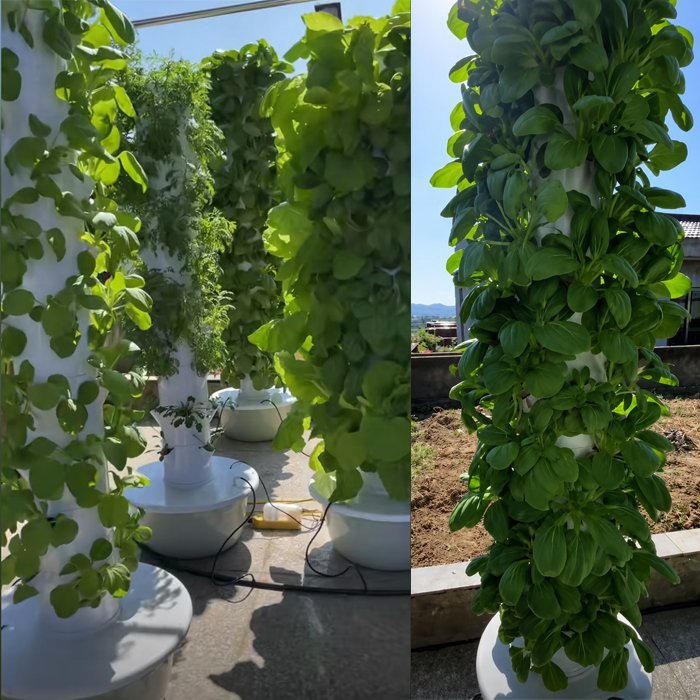
Scaling a hydroponic operation from a handful of towers to 100 units is a major leap — and a commercially viable one. A 100-tower farm can produce 8,000–12,000 heads of lettuce or leafy greens per harvest cycle, making it an attractive scale for small-to-medium commercial growers, educational institutions, hotels supplying their own kitchens, and community agriculture projects.
This guide walks through every stage of the setup: space planning, equipment selection, irrigation and nutrient delivery, environmental control, labor planning, and the real numbers behind the investment. If you are a buyer evaluating tower systems for a mid-size installation, this is your blueprint.
The first question every buyer asks is: how much space does a 100-tower farm require? The answer depends on tower spacing, walkway access, and whether you are growing indoors (greenhouse or warehouse) or outdoors.
| Configuration | Tower Spacing (centre-to-centre) | Rows | Total Floor Area | Notes |
|---|---|---|---|---|
| Indoor — dense layout | 0.8 m × 0.8 m | 10 rows × 10 towers | ~80 m² (860 ft²) | Tight walkways, requires rolling benches or narrow aisle carts |
| Indoor — standard layout | 1.0 m × 1.0 m | 10 rows × 10 towers | ~120 m² (1,290 ft²) | Comfortable walkways, standard maintenance access |
| Greenhouse — staggered | 1.2 m (row) × 0.8 m (in-row) | 8 rows × 12–13 towers | ~150 m² (1,615 ft²) | Accounts for greenhouse support columns, ventilation paths |
| Outdoor / open-air | 1.0 m × 1.0 m | 10 rows × 10 towers | ~130 m² (1,400 ft²) | Includes perimeter clearance for wind protection, sun exposure management |
Key spacing rule: Each tower needs at least 0.8 m of clearance on all sides for planting, harvesting, and nutrient checks. Dense layouts work for automated facilities but are not recommended for manual operations — your team needs room to work efficiently.
For a standard indoor layout at 1.0 m spacing, plan for approximately 120–150 m² of usable growing space, plus another 20–30 m² for a nutrient mixing station, reservoir area, and storage.
A 100-tower farm is not just 100 towers — it is a complete production system. Here is the full equipment breakdown:
| Category | Item | Qty / Spec | Estimated Cost (USD) |
|---|---|---|---|
| Growing units | Hydroponic towers (9-layer, 45-site) | 100 units | $8,000–$15,000 |
| Irrigation | Submersible pump (1,500–3,000 L/h) | 2 units (1 primary + 1 backup) | $200–$500 |
| Irrigation | Main supply line (25 mm PVC or PE) | ~100 m | $150–$300 |
| Irrigation | Drip manifolds + distribution tubing (8 mm) | 100 sets | $400–$800 |
| Nutrient | Reservoir tank (500–1,000 L) | 2 tanks | $400–$1,000 |
| Nutrient | pH/EC meter (handheld or inline) | 2 units | $100–$300 |
| Nutrient | Nutrient solution (A + B concentrate, initial batch) | ~200 L concentrate | $500–$1,000 |
| Growing media | Hydroponic grow cubes / clay pebbles / coco coir | 4,500 sites (45 per tower) | $300–$800 |
| Lighting (indoor) | LED grow lights (full spectrum, 100 W equivalent per 2 towers) | 50 units | $3,000–$6,000 |
| Environment | Circulation fans | 4–6 units | $200–$600 |
| Environment | Timer / controller for pump and lights | 2 smart controllers | $150–$400 |
| Setup | Grow trays / saucers (for drip collection) | 100 units | $500–$1,000 |
| Setup | Shelving or support frames (if multi-tier layout) | As needed | $1,000–$3,000 |
Total estimated equipment investment: $15,000–$32,000 depending on tower model, automation level, and whether you choose indoor or greenhouse configuration.
A 100-tower farm requires careful irrigation design. Each tower needs consistent water and nutrient delivery — uneven flow means uneven crop growth.
Option A: Single-zone system
Option B: Zoned system (recommended for 100 towers)
Efficient layout is about minimizing walking distance. Your farm team will walk between towers hundreds of times per day — good layout design saves hours of labor weekly.
Recommended layout for 100 towers (standard indoor, 1.0 m spacing):
This linear flow design (planting → growing → harvesting → packing) eliminates backtracking and keeps your operation efficient as you scale.
Managing nutrients for 4,500+ growing sites is different from running a hobby setup. Key considerations:
A 100-tower farm can be operated by:
| Role | Hours / Week | Key Responsibilities |
|---|---|---|
| Farm manager | 30–40 | Overall operations, nutrient management, crop scheduling, order management |
| Planting & harvesting technician | 20–30 | Seeding, transplanting, harvesting, cleaning towers between cycles |
| Maintenance technician | 10–15 | Pump and plumbing checks, pH/EC monitoring, pest scouting, system repairs |
Total: 1.5–2 full-time equivalent (FTE) staff. With proper workflow design and automation (timed irrigation, auto-dosing), this can reduce to approximately 1 FTE for routine operations.
Based on feedback from commercial growers who have deployed 50–200 tower farms:
| Category | Estimated Cost (USD) |
|---|---|
| Hydroponic towers (100 units) | $8,000–$15,000 |
| Irrigation system (pumps, pipes, fittings, tubing) | $1,000–$2,000 |
| Reservoir tanks, meters, controllers | $1,000–$2,000 |
| Growing media and nutrient concentrate (initial) | $800–$1,800 |
| Lighting (indoor only) | $3,000–$6,000 |
| Environmental controls (fans, timers) | $500–$1,200 |
| Furniture, shelving, wash station, tools | $1,500–$3,000 |
| Installation labor / contractor | $2,000–$5,000 |
| Total (indoor with lighting) | $18,000–$36,000 |
| Total (greenhouse, natural light) | $15,000–$30,000 |
With a 28–35 day growing cycle (lettuce, basil, kale, Swiss chard):
| Metric | Per Cycle (28–35 days) | Annual (10 cycles) |
|---|---|---|
| Growing sites | 4,500 | — |
| Harvest yield (heads of lettuce or equivalent) | 3,500–4,000 | 35,000–40,000 |
| Estimated weight | 350–500 kg | 3,500–5,000 kg |
| Revenue (at $2.50/head wholesale) | $8,750–$10,000 | $87,500–$100,000 |
| Revenue (at $4.00/head retail/direct) | $14,000–$16,000 | $140,000–$160,000 |
Note: Actual yield depends on crop type, climate, and grower experience. Figures assume 85–90% occupancy rate and standard leafy green cultivation.
A 100-tower hydroponic farm is a serious commercial investment that, properly planned and executed, can generate strong returns within 12–18 months. The key is not the hardware — it is the system design: water flow, nutrient management, workflow efficiency, and backup planning.
SpaceTree offers factory-direct hydroponic towers designed specifically for commercial scale-up. Our 9-layer vertical towers (45 growing sites per unit) are engineered for consistent water distribution, easy maintenance, and modular expansion from 20 to 200+ towers.
Whether you are planning your first 20-tower pilot or ready to deploy 100 units, our team can help with layout design, irrigation schematics, and equipment specification tailored to your facility.
