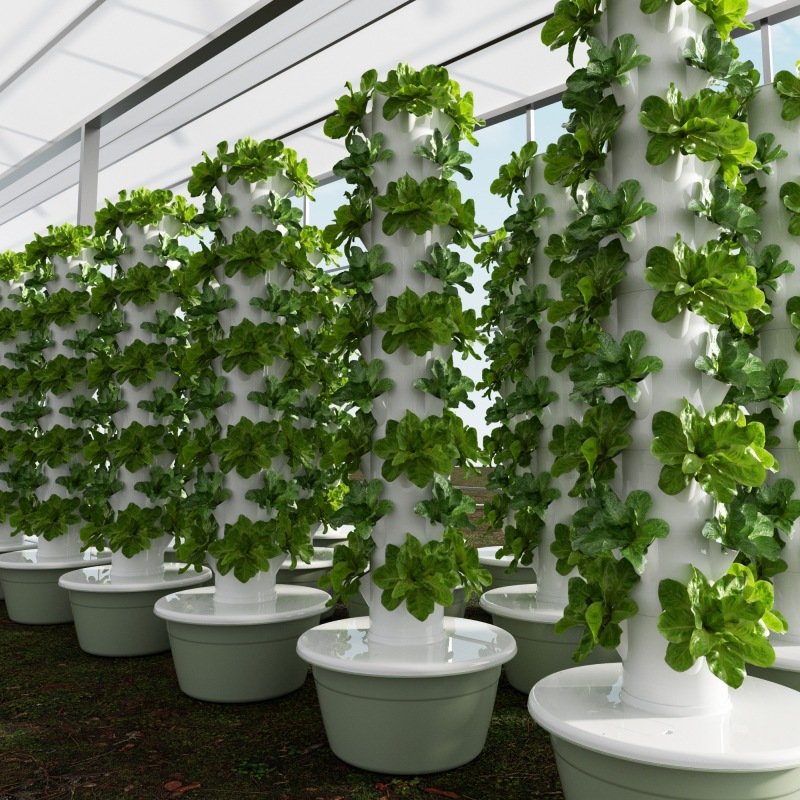
Vertical hydroponic tower systems are revolutionizing lettuce production worldwide. This case study examines how greenhouse-based hydroponic tower cultivation of lettuce delivers superior economic returns and operational efficiency compared to traditional soil-based farming methods.
Why Lettuce?
Lettuce is an ideal crop for hydroponic cultivation due to its:
- Short growth cycle: 30-45 days from seed to harvest
- Shallow root system: Perfectly suited for tower systems
- High market demand: Year-round consumption
- Premium pricing: Fresh, clean, pesticide-free lettuce commands higher prices
System Configuration
A typical commercial hydroponic tower lettuce farm features:
- Tower height: 1.5-2 meters with 10-15 planting tiers
- Plants per tower: 40-60 lettuce heads depending on variety
- Footprint: 1.5-2.5 m² per tower
- Greenhouse environment: Climate-controlled for optimal growth
Productivity Comparison
Hydroponic Tower System:
- Planting density: 25-35 plants/m²
- Growth cycle: 30-35 days (faster than soil)
- Annual harvests: 10-12 cycles/year
- Yield per plant: 200-300g per head
Traditional Soil Cultivation:
- Planting density: 4-8 plants/m²
- Growth cycle: 45-60 days
- Annual harvests: 4-6 cycles/year
- Yield per plant: 150-250g per head
Productivity Advantage: Hydroponic towers produce 5-7 times more lettuce per square meter annually compared to soil cultivation.
Economic Efficiency Advantages
1. Accelerated Growth Rates
Hydroponic lettuce grows 30-50% faster than soil-grown counterparts due to:
- Optimal nutrient delivery directly to roots
- Controlled environment eliminating weather stress
- Consistent pH and EC levels
- Superior oxygen availability to root zones
2. Water Conservation
Hydroponic systems use 85-95% less water than traditional farming:
- Closed-loop circulation minimizes evaporation
- No water loss to soil percolation
- Precise delivery eliminates runoff
- Particularly valuable in water-scarce regions
3. Nutrient Efficiency
Fertilizer utilization in hydroponics reaches 90-95% compared to 30-50% in soil:
- Nutrients delivered in soluble form
- Recirculating systems capture unused nutrients
- No leaching into groundwater
- Reduced input costs and environmental impact
4. Labor Optimization
Vertical tower design improves labor efficiency by 40-60%:
- Ergonomic working height reduces bending
- Streamlined harvesting processes
- Easier pest monitoring and management
- Reduced weeding (no soil = no weeds)
5. Pest and Disease Control
Greenhouse hydroponic systems achieve 80-90% reduction in pesticide use:
- Physical barriers exclude pests
- No soil-borne pathogens
- Controlled environment prevents disease spread
- Cleaner product with longer shelf life
6. Year-Round Production
Climate-controlled greenhouses enable:
- Continuous harvesting regardless of season
- Stable supply to markets
- Premium pricing during off-season periods
- Predictable cash flow for business planning
Quality Advantages
Hydroponic greenhouse lettuce offers superior quality characteristics:
- Cleaner product: No soil contamination, minimal washing required
- Consistent size and appearance: Uniform growing conditions
- Extended shelf life: 7-14 days longer than field-grown
- Nutritional quality: Optimized nutrient profiles
- Food safety: Reduced pathogen risk (E. coli, Salmonella)
Key Advantages Summary
- Space Efficiency: 5-7 times higher annual yield per square meter
- Water Savings: 85-95% reduction in water consumption
- Faster Growth: 30-50% shorter production cycles
- Higher Quality: Cleaner, more consistent, longer shelf life
- Reduced Chemicals: 80-90% less pesticide use
- Labor Efficiency: 40-60% improvement in worker productivity
- Year-Round Income: 10-12 harvest cycles annually
- Environmental Sustainability: Minimal runoff and pollution
Market Positioning
Hydroponic greenhouse lettuce commands premium market positioning:
- Local production: Reduced transportation, fresher product
- Sustainable branding: Appeals to environmentally conscious consumers
- Food safety certification: Easier to achieve GAP, organic certifications
- Restaurant partnerships: Consistent supply for hospitality sector
- Retail contracts: Supermarkets value reliable year-round supply
Conclusion
Hydroponic tower greenhouse cultivation represents a transformative approach to lettuce production. The combination of dramatically higher productivity, superior resource efficiency, enhanced quality, and year-round production capability makes this system economically superior to traditional soil farming.
For commercial growers seeking sustainable profitability, hydroponic tower systems offer a proven pathway to higher yields, lower operational costs, premium product positioning, and reduced environmental impact. This is not merely an incremental improvement—it represents a fundamental shift toward the future of efficient, responsible agriculture.
(Featured image: Vertical hydroponic lettuce towers in a modern greenhouse facility)