Our Location
304 North Cardinal St.
Dorchester Center, MA 02124

304 North Cardinal St.
Dorchester Center, MA 02124

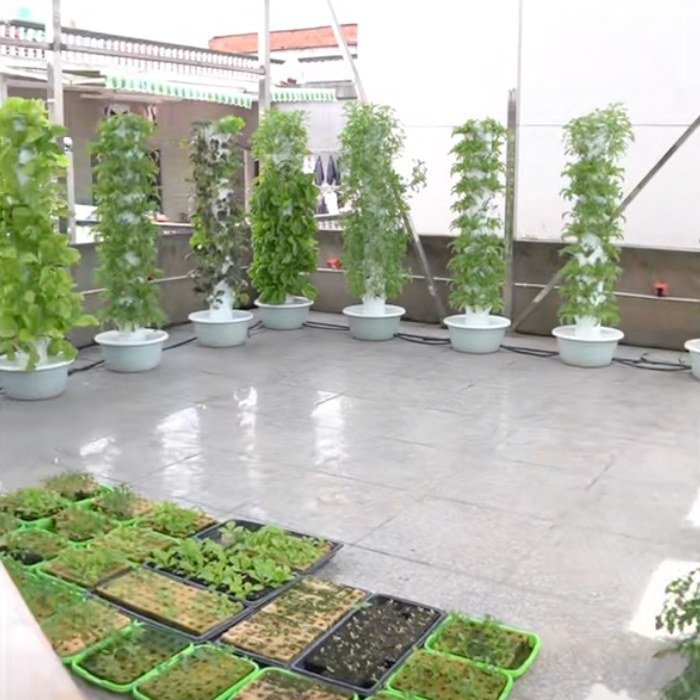
If you’re shopping for a vertical growing system, you’ve probably hit the same wall: every supplier seems to sell either a hydroponic tower or an aeroponic system — and both claim to be the future of farming. The marketing makes them sound almost identical, but underneath the plastic they are very different machines with very different operating costs, failure modes, and labor demands.
This guide compares the two technologies on the five factors that actually move the needle for a commercial operation: upfront cost, day-to-day maintenance, fault tolerance, yield, and scalability. By the end, you’ll know exactly which system belongs in your greenhouse — and which one will quietly eat your margins.
A hydroponic tower is a vertical column with growing pockets along its sides, fed by a small pump that circulates nutrient solution from a reservoir at the base to the top of the tower. The solution then drips or trickles back down through the growing medium, past every root zone, and returns to the reservoir. Nozzles may be involved, but the system works even if one of them clogs — the nutrient film simply flows around it.
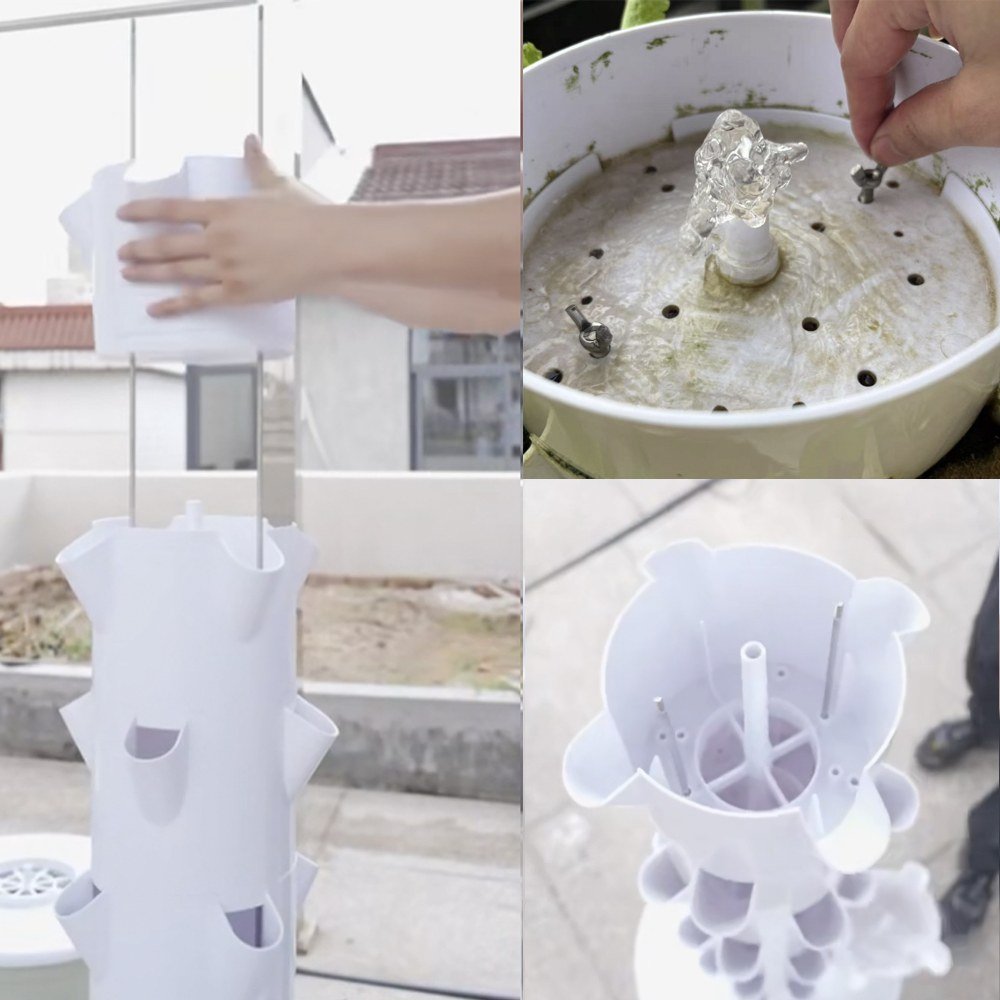
The design is deliberately low-tech. There is no misting chamber, no high-pressure pump, no solenoid valves. Water and nutrients are delivered by gravity and a basic submersible pump — the same pump you’d find in a $30 pond fountain. That simplicity is the entire point: fewer moving parts means fewer things to fail in the middle of a growing cycle.
Aeroponics suspends plant roots in a sealed, dark chamber and sprays them with a fine nutrient mist every few seconds. Because the roots hang in air, they get oxygen saturation that no submerged or film-based system can match — which is why aeroponics holds the theoretical top spot for root-zone growth speed.
The catch: that mist only exists if every nozzle stays perfectly clear. Aeroponic systems run high-pressure pumps (typically 60–120 psi) and misting nozzles with orifices measured in fractions of a millimeter. A single clogged nozzle starves a section of roots in hours — not days. And in hard-water areas, mineral scale buildup on nozzles is not a question of if, but when.
| Factor | Hydroponic Tower | Aeroponic System |
|---|---|---|
| Upfront cost per growing point | Low — simple pump + gravity feed | High — high-pressure pump, misting nozzles, sealed chambers, timers |
| Daily maintenance | Check pH/EC, top up reservoir | Check pH/EC plus inspect & clean every nozzle |
| Fault tolerance | High — a clogged nozzle barely matters, flow finds another path | Low — one clogged nozzle kills that root zone in hours |
| Yield potential | Very good, consistent | Theoretically higher, but only when every component runs perfectly |
| Power requirement | Low — submersible pump, ~30–60 W | High — 60–120 psi pump runs frequently, more energy per growing point |
| Repair complexity | Swap a $30 pump, done | Diagnose pressure loss, disassemble lines, replace nozzles |
For the same number of growing points, an aeroponic system typically costs 2–3× more to purchase and install. The high-pressure pump, misting manifold, solenoid timers, and sealed root chambers add up fast. A hydroponic tower, by contrast, is mostly molded plastic and a cheap submersible pump. If you’re scaling to hundreds or thousands of towers, this gap compounds into a six-figure difference — money you could spend on greenhouse space, lighting, or labor instead.
Aeroponics is unforgiving as a daily routine. Every nozzle needs visual inspection because misting orifices clog with mineral scale, algae, and root debris. In hard-water regions, growers report cleaning nozzle banks weekly. Hydroponic towers don’t have this failure mode: water flows by gravity through the column, and the only regular tasks are checking pH/EC and topping up the reservoir. For a commercial operation, that difference is hours of labor per week — every week, all season.
This is the factor most comparison guides skip, and it’s the one that decides whether your crop survives a bad week. In an aeroponic chamber, roots have no growing medium — they live or die by the mist. A pump failure, power cut, or clogged line means roots dry out and die within hours, and there is no recovery. In a hydroponic tower, roots sit in growing medium (like coco coir or clay pebbles) that stays moist even if circulation stops for a while. A pump failure costs you a repair, not a crop. For any farm where “the system must not kill my plants” is a requirement — which is every farm — towers win this category outright.
Aeroponics genuinely grows roots faster in controlled trials, and its advocates will quote impressive grams-per-plant figures. But those figures come from research-grade setups with daily monitoring. In real commercial conditions — with real water, real staffing, and real schedules — the yield gap narrows dramatically, and aeroponic farms routinely lose yield to nozzle failures and uneven mist distribution. A well-run tower farm produces consistent, predictable harvests week after week, which is worth more to a wholesale buyer than a theoretical 10–15% edge that can vanish overnight.
Both systems stack vertically, but towers scale more gracefully. Adding towers means adding independent, self-contained units — a new pump and reservoir per tower or row. Aeroponic systems scale as one interconnected pressure network: every added chamber increases line length, pressure drop, and the number of nozzles that can fail. Maintenance crews also prefer towers: you can inspect and service one unit without shutting down the whole zone. And when a tower reaches end-of-life, you replace one column, not a section of manifold plumbing.
Here’s the honest decision framework:
For 95% of commercial growers — from greenhouse vegetable producers to rooftop farms and school-to-table operations — the hydroponic tower is the better business decision. It trades a theoretical yield ceiling for something far more valuable: reliability you can plan a harvest calendar around.
Where you buy your towers matters as much as which technology you choose. Most tower brands you’ll find online are distributors marking up systems that come from the same Chinese factories. Buying factory-direct cuts out 2–3 layers of markup, and it means you can get towers customized — hole counts, column heights, colors, and branding — to fit your exact grow plan.
At SpaceTree, we manufacture hydroponic towers in our own facility and ship directly to farms worldwide. No middlemen, no brand premiums, no “white-label surcharge” — just the system itself, priced at factory level. We also supply replacement parts (pumps, reservoirs, growing cups) in bulk, so your maintenance stock doesn’t depend on a distributor’s import schedule.
Not sure which tower configuration fits your greenhouse? Tell us your crop plan and square footage, and we’ll recommend a layout with exact quantities and a quote.
