Our Location
304 North Cardinal St.
Dorchester Center, MA 02124

304 North Cardinal St.
Dorchester Center, MA 02124

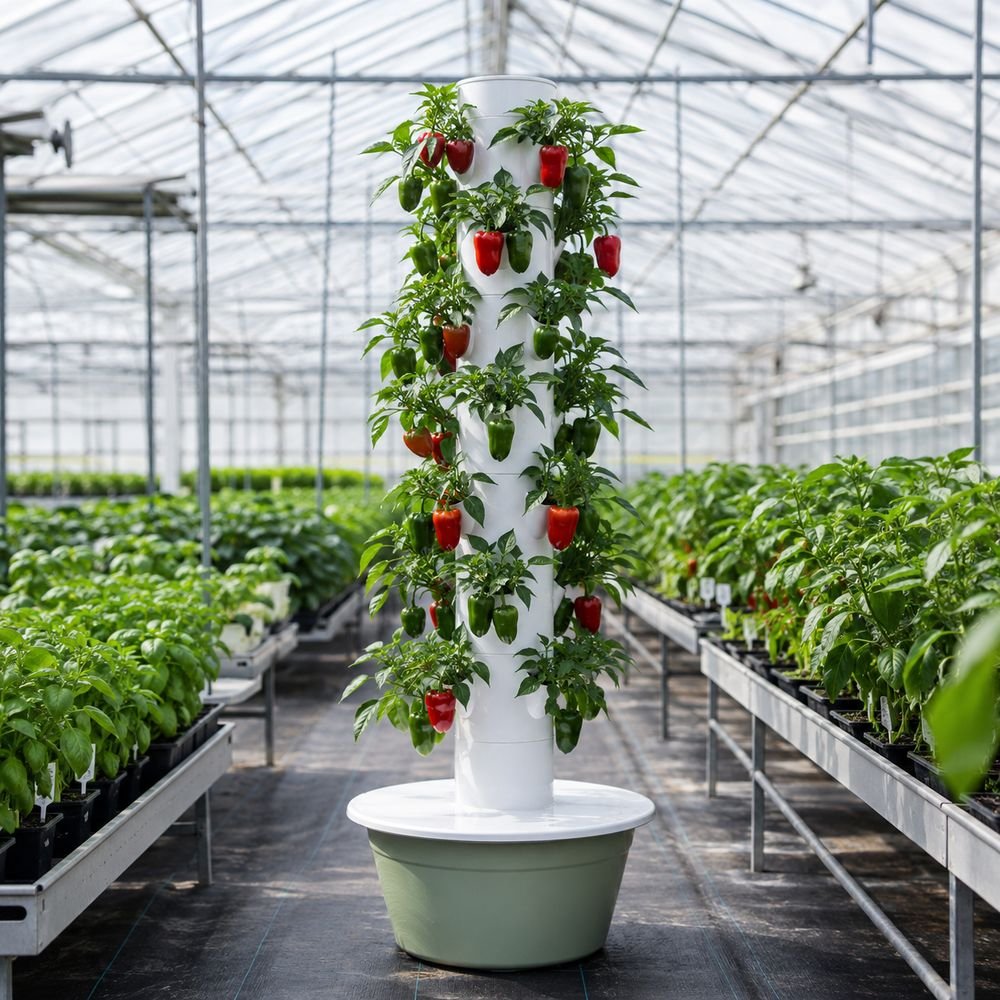
If you run hydroponic towers commercially — or are planning to — there is one number that tells you more about crop health than almost anything else: the EC of your nutrient solution. Get it right and your lettuce grows fast, uniform, and market-ready. Get it wrong and you will spend weeks chasing yellow leaves, tip burn, and stunted growth without knowing why.
This guide covers what EC and PPM actually mean, the target ranges for the most common tower crops, how to measure accurately, and a simple step-by-step routine for adjusting nutrient strength. By the end, you will be able to read your nutrient solution the way an experienced grower does — and keep your towers producing at full capacity.
EC (electrical conductivity) measures how well your water conducts electricity — which comes directly from the dissolved mineral salts, i.e. the nutrients. A higher EC means more fertilizer is dissolved in the water. It is reported in millisiemens per centimeter (mS/cm) or microsiemens (µS/cm): 1.0 mS/cm = 1000 µS/cm.
PPM (parts per million) is an estimate of the actual mass of dissolved solids in the solution. Here is the catch: different meters convert EC to PPM using different scales — the 500 scale, the 640 scale, or the 700 scale. That is why one grower’s “800 ppm” is another grower’s “1120 ppm” for the exact same solution.
Your EC meter and your PPM meter can disagree without either one being broken. Always know which conversion scale your meter uses, and always take measurements with the same meter so your records stay comparable.
| EC (mS/cm) | PPM — 500 scale | PPM — 700 scale |
|---|---|---|
| 0.5 | 250 | 350 |
| 1.0 | 500 | 700 |
| 1.5 | 750 | 1050 |
| 2.0 | 1000 | 1400 |
| 2.5 | 1250 | 1750 |
| 3.0 | 1500 | 2100 |
In a hydroponic tower, plants sit in small net pots while nutrient solution recirculates from a compact reservoir. Two things happen that make EC management more demanding than in a large NFT or DWC system:
If you never measure EC, you are flying blind. Low EC starves plants and slows growth; high EC burns root tips and locks out calcium — which shows up as tip burn on lettuce and blossom-end rot on tomatoes and peppers. Both problems look like diseases, but they are almost always nutrient management issues.
Use this table as your starting point. Seedlings and young plants should stay at the low end; mature, fruiting plants should run at the high end. These ranges are for the standard 500-scale PPM conversion.
| Crop | Seedling EC (mS/cm) | Mature EC (mS/cm) | Mature PPM (500 scale) |
|---|---|---|---|
| Lettuce & leafy greens | 0.8 – 1.0 | 1.0 – 1.4 | 500 – 700 |
| Kale & Swiss chard | 1.2 – 1.5 | 1.5 – 2.0 | 750 – 1000 |
| Basil, mint & herbs | 0.8 – 1.0 | 1.2 – 1.8 | 600 – 900 |
| Strawberries | 0.8 – 1.0 | 1.2 – 1.8 | 600 – 900 |
| Tomatoes | 1.0 – 1.5 | 2.0 – 3.5 | 1000 – 1750 |
| Peppers | 1.0 – 1.5 | 1.8 – 2.5 | 900 – 1250 |
| Cucumbers | 1.0 – 1.5 | 1.7 – 2.5 | 850 – 1250 |
Every crop variety has its own sweet spot. Start in the middle of the range, watch how the plants respond for a few days, then fine-tune. Keeping a simple log — EC reading, date, growth stage, and what you adjusted — turns guesswork into a repeatable recipe within two or three crop cycles.
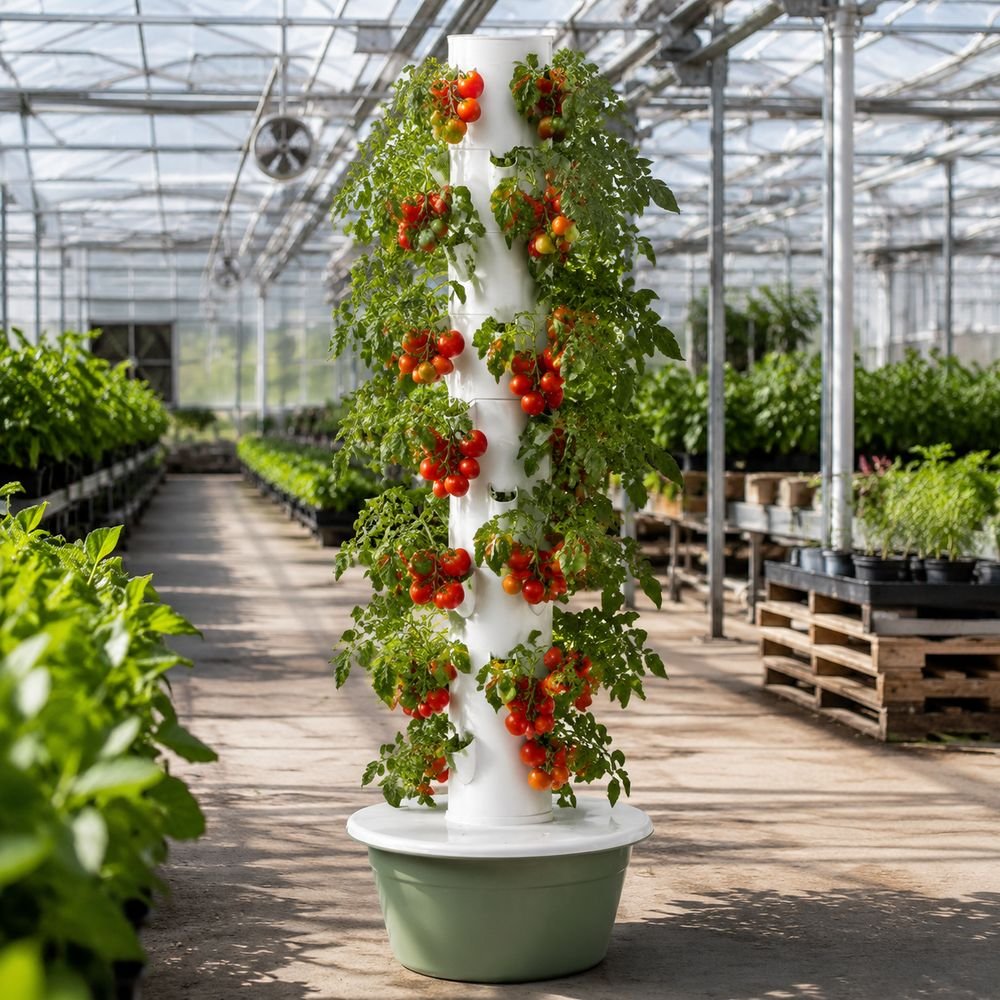
Measuring EC is a two-minute job, but small habits make the difference between a trustworthy reading and a misleading one.
If the EC is too low (plants are hungry): add concentrated nutrient solution in small increments. Mix the concentrate in a separate bucket of water first, then pour it into the reservoir — never pour concentrate directly onto the roots. Add about 10–20% of the amount you think you need, recirculate for 30–60 minutes, and re-measure. Repeat until you hit the target range.
If the EC is too high (solution is over-concentrated): add plain water to dilute. This is the more common problem in towers during warm weather, because evaporation concentrates the solution faster than the plants can eat. Top up with fresh water, recirculate, and re-measure after 30–60 minutes.
Never make big jumps. A sudden swing of 0.5 mS/cm or more stresses roots and can trigger tip burn and leaf edge burn even if you end up at the “right” number. Small, staged adjustments keep the plants in steady state — which is what actually drives consistent commercial yield.
When the EC keeps climbing no matter how much water you add, or the reading drifts day after day, it is usually time to change the reservoir. See our guide on how often to change water in a hydroponic tower for a full reservoir management schedule.
Your EC reading is a diagnostic tool. Use this quick-reference table to turn an odd number into an action plan.
| What you see | Most likely cause | Fix |
|---|---|---|
| EC climbs steadily through the day | Water evaporating faster than nutrients are absorbed | Top up with fresh water; check water temperature; consider shade or cooling |
| EC drops day after day | Plants consuming nutrients faster than you are adding them | Add concentrated nutrient solution in small increments |
| EC swings up and down randomly | Probe dirty, uncalibrated, or measuring at different times | Clean the probe, calibrate with 1413 µS/cm standard, measure at a fixed time daily |
| Leaf edges brown and crispy; dark green leaves | EC too high — salt burn | Dilute with fresh water; check the feeding schedule; flush if severe |
| Pale, slow growth; yellowing lower leaves | EC too low — nutrient deficiency | Add nutrient concentrate in staged increments |
| Tip burn on lettuce; blossom-end rot on fruiting crops | Calcium lockout — often caused by high EC or high heat | Lower EC back into range, check pH, improve airflow |
| Meter reads zero or refuses to stabilize | Dead battery, failed probe, or empty reservoir | Replace battery or probe; refill reservoir |
If yellow leaves or slow growth persist after fixing your EC, work through the hydroponic tower troubleshooting guide — it covers pH, root rot, and oxygen issues that show the same symptoms.
For a single hobby tower, eyeballing is fine. For a commercial farm, EC management is a daily operating procedure with three parts:
EC is only half of the nutrient equation. Pair your EC routine with proper pH and water quality management, and build your feed program from a solid base with our complete hydroponic tower nutrient solution guide.
EC and PPM are not chemistry homework — they are the simplest reliable window into what is happening in your root zone. Measure at the same time daily, keep the meter calibrated, adjust in small steps, and log what you do. Three weeks of consistent EC management will tell you more about your system than a year of guessing.
Running a tower farm and want to talk through nutrient management for your setup? Our team builds factory-direct hydroponic towers for commercial growers worldwide and can help you spec a system that matches your crops, water quality, and scale.
