Our Location
304 North Cardinal St.
Dorchester Center, MA 02124

304 North Cardinal St.
Dorchester Center, MA 02124


Strawberries are one of the highest-value crops you can put in a hydroponic tower — retail prices of $4–$6 per pound, year-round production, and a footprint that makes leafy greens look like a commodity. But they are also the crop that trips up more first-time tower growers than any other. In an indoor or greenhouse tower system there is no wind and no bees, and if you do not replace them, you get deformed fruit instead of profit. This guide walks commercial growers through the full strawberry grow cycle in a tower: variety selection, planting, light and temperature, pollination, pruning, feeding, harvesting, and the problems that quietly kill crops.
Before we get into the how, it is worth being clear about the why. Strawberries earn roughly three to four times the retail price of lettuce per pound, and day-neutral varieties keep producing for 9–10 months instead of finishing in one cut. On a 12-layer tower with 48 planting ports, a single tower can carry 48 fruiting plants in about 2 square feet of floor space. That combination — premium pricing, continuous harvest, and vertical density — is why strawberry towers appear in more commercial farm plans every year.
| Metric (per sq ft of floor space) | Leafy Greens | Strawberries |
|---|---|---|
| Typical retail price per lb | $3–$5 | $4–$6 (premium: $8–$12) |
| Harvest window | Single cut, 3–4 weeks | 9–10 months (day-neutral) |
| Plants per 12-layer tower | 48 | 48 |
| Annual revenue potential per tower | Moderate, steady | High, but requires daily attention |
The trade-off is real: strawberries are not a set-and-forget crop. They need pollination management, regular pruning, and tighter nutrient control than most greens. Every hour of that attention pays off at harvest, because the same tower footprint that earns a few dollars a week in lettuce can earn several times more in berries.
Your variety choice decides your entire production model, so this is the first decision to make. Strawberry varieties fall into three groups based on how they respond to day length, and only one of them is built for continuous tower production.
| Variety Type | Fruiting Pattern | Right for Towers? | Recommended Commercial Varieties |
|---|---|---|---|
| June-bearing | One large crop, 2–3 weeks in late spring | No — long idle periods waste tower space | Chandler, Camarosa |
| Everbearing | Two to three flushes per season | Partially — gaps between flushes | Seascape, Ozark Beauty |
| Day-neutral | Continuous fruiting under 12–16h light | Yes — the standard for towers | Albion, San Andreas, Monterey |
For commercial tower farms, day-neutral varieties are the clear winner. Albion and San Andreas are the most widely used in vertical systems because they produce firm, high-flavor berries, tolerate warmer root zones, and keep flowering as long as conditions stay in range. If you are sourcing plants from a tissue-culture supplier, ask specifically for day-neutral cultivars adapted to protected cultivation. For more on which crops earn their place in a tower, see our guide to the best crops for hydroponic towers.
Most commercial growers start from bare-root crowns or plug plants rather than seed — seeds are slow and unreliable for production. Bare-root crowns are cheaper and fine for spring planting; plug plants (raised in rockwool or coco cubes) give you a faster, more uniform start and are the better choice when you are filling a tower with 48 plants that need to fruit on the same schedule.
Transplanting technique matters more than most growers expect: crown depth mistakes and root damage in the first week account for a large share of early strawberry failures. Our step-by-step seedling transplant guide covers rockwool preparation and the 10–14 day timing window that gives plants their best start.
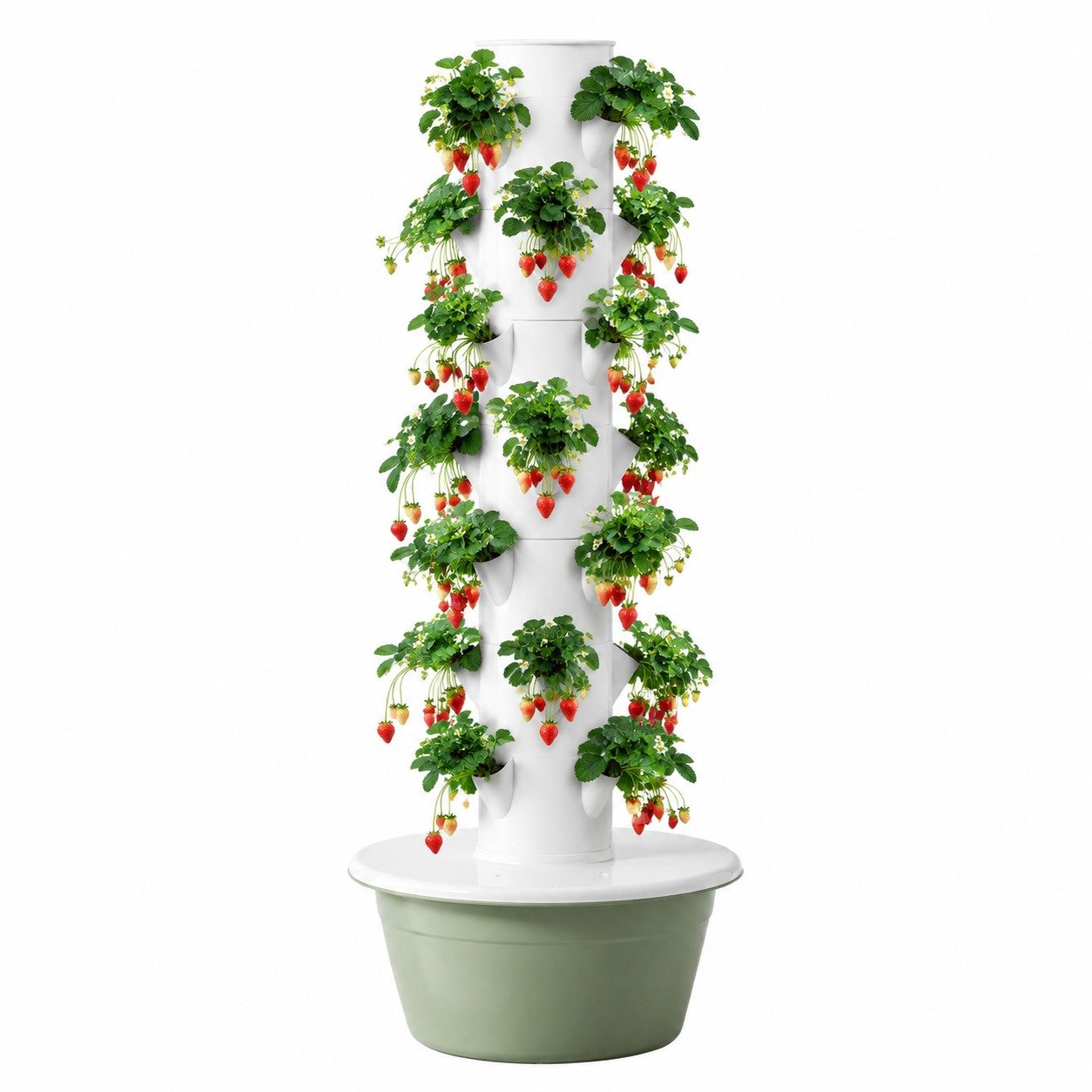
Day-neutral strawberries are not as demanding as tomatoes, but they have a narrow comfortable window. Target a photoperiod of 14–16 hours and a daily light integral (DLI) of 15–20 mol/m²/day at canopy level. Below about 12 mol/m²/day, flowering slows and berries turn small and pale; above 25 mol/m²/day with warm air, you risk heat stress that stalls fruit set.
| Parameter | Target Range | Notes |
|---|---|---|
| Photoperiod | 14–16 hours | Keeps day-neutral varieties flowering |
| DLI at canopy | 15–20 mol/m²/day | Use LED bars or tower-integrated LED lighting |
| Daytime air temperature | 18–24°C (64–75°F) | Above 27°C reduces fruit set |
| Night temperature | 10–13°C (50–55°F) | Cool nights improve flavor and color |
| Root zone temperature | 15–20°C (59–68°F) | Warm nutrient solution slows fruiting |
If you grow in a greenhouse, watch summer heat carefully — strawberry fruit set drops sharply above 27°C, which is one reason tower farms in hot climates run their strawberry rooms separately from leafy greens. Our LED lighting guide covers spectrum and coverage planning, and the summer heat management guide explains how to keep towers cool when temperatures climb.
This is the step that separates successful strawberry towers from everyone else. Strawberries are self-fertile — each flower contains both male and female parts — but the pollen still needs to be moved from the anthers to the central receptacle, and in nature that job is done by wind and bees. Inside a greenhouse or indoor farm, neither exists. If you do nothing, you get the classic symptom: misshapen, half-developed berries that look like they were squeezed.
| Pollination Method | Cost | Labor | Best For |
|---|---|---|---|
| Soft brush (paintbrush / makeup brush) | ~$5 | High — brush every open flower, daily | Fewer than 50 plants |
| Electric toothbrush vibration | ~$15 | Medium — touch each flower cluster briefly | Up to a few hundred plants |
| Oscillating fans (air movement) | ~$30–60 per fan | None after setup | Good supplement at any scale |
| Bumblebee hives | ~$150–300 per hive | None — bees do it all | Commercial scale (100+ towers) |
The most reliable commercial setup combines continuous air movement from oscillating fans (which also helps disease prevention) with bumblebees in the fruiting room. For small operations, a daily pass with a vibrating electric toothbrush over each open flower cluster is genuinely effective — the vibration releases pollen the same way a bee’s wing buzz does. Pollinate every day during peak flowering: flowers are receptive for only a few days, and missed flowers become misshapen berries you cannot sell.
Strawberries are aggressive about reproduction, and in a tower you have to override that instinct. Runners (the long stems that try to root new baby plants) and old leaves drain energy from fruit production. A plant allowed to make runners can cut berry yield by 30% or more.
Budget 10–15 minutes per 48-port tower per week for pruning. It sounds like small work, but it is the difference between a tower that yields all season and one that exhausts itself by mid-summer.
Strawberries are more salt-sensitive than leafy greens and they have a big calcium appetite — calcium deficiency shows up as soft, blotchy berries and curled new leaves. Keep the reservoir pH at 5.5–6.0 and adjust EC as the plant moves through its life cycle.
| Growth Stage | EC Target (mS/cm) | pH Target | Feeding Notes |
|---|---|---|---|
| Establishment (weeks 1–2) | 1.0–1.2 | 5.5–6.0 | Low EC while roots establish |
| Vegetative growth | 1.2–1.4 | 5.5–6.0 | Balanced formula, higher nitrogen |
| Flowering | 1.4–1.6 | 5.5–5.8 | Boost phosphorus and potassium |
| Fruiting & harvest | 1.6–1.8 | 5.5–5.8 | High potassium; keep calcium available |
Two practical tips from commercial strawberry tower operators: keep calcium and potassium in separate stock tanks so they never precipitate, and check EC daily — small reservoirs in towers concentrate nutrients fast as plants drink, and a spike above 2.0 mS/cm burns root tips within a day. Our nutrient solution guide explains formulation, and the EC/PPM measurement guide covers meter calibration and adjustment in detail.
Pick berries when they are fully red to the tip — including the white shoulder at the calyx, which is the last part to color. Berries do not ripen further after picking, so early picking sacrifices flavor and shelf appeal. Because day-neutral plants ripen continuously, plan to harvest every 2–3 days during peak production.
| Metric | Realistic Range (Day-Neutral, Tower) |
|---|---|
| Yield per plant per season | 0.5–1.5 lb (0.25–0.7 kg) |
| Yield per 48-port tower per season | 24–70 lb (11–32 kg) |
| Time from planting to first harvest | 8–12 weeks (from plugs) |
| Berries per plant at peak | 3–6 per week |
| Shelf life (refrigerated, unwashed) | 5–7 days |
Harvest in the morning when berries are coolest, handle them by the calyx rather than the flesh, and refrigerate within an hour — field heat is the biggest driver of short shelf life. Berries destined for restaurants and farmers markets command the premium price only when they arrive intact. For pricing and channel strategy, see our guide to selling hydroponic produce.
Strawberry-specific problems usually announce themselves in the fruit, which makes them easy to catch if you walk the towers daily. Here is the quick-diagnosis table our grower customers find most useful:
| Symptom | Likely Cause | First Step |
|---|---|---|
| Misshapen, half-formed berries | Poor pollination | Add vibration pollination or bumblebees; check fans |
| White powdery coating on leaves and fruit | Powdery mildew | Increase airflow, lower humidity, remove infected leaves |
| Fine webbing and stippled yellow leaves | Spider mites | Isolate the tower; predatory mites or targeted spray |
| Gray fuzzy mold on ripe fruit | Botrytis (gray mold) | Remove infected berries, improve airflow, harvest sooner |
| Soft, blotchy, or misshapen fruit with leaf tip burn | Calcium deficiency | Check EC/pH; add calcium supplement to reservoir |
| Small pale berries, slow flowering | Insufficient light | Raise DLI to 15–20 mol/m²/day |
Most of these issues are prevented by the same three habits: daily air movement, clean pruning, and keeping humidity below 65% during fruiting. Our pest control guide covers IPM protocols, and the troubleshooting guide handles yellow leaves and root problems when they appear.
The economics of strawberries get better as you scale, because pollination and harvest labor spread across more towers. Operators typically start with 10–20 towers to validate their variety, lighting, and market, then scale in blocks of 20–50 towers once the routine is dialed in. A 100-tower strawberry room running day-neutral varieties can supply a steady stream of berries through local wholesale and restaurant channels for most of the year.
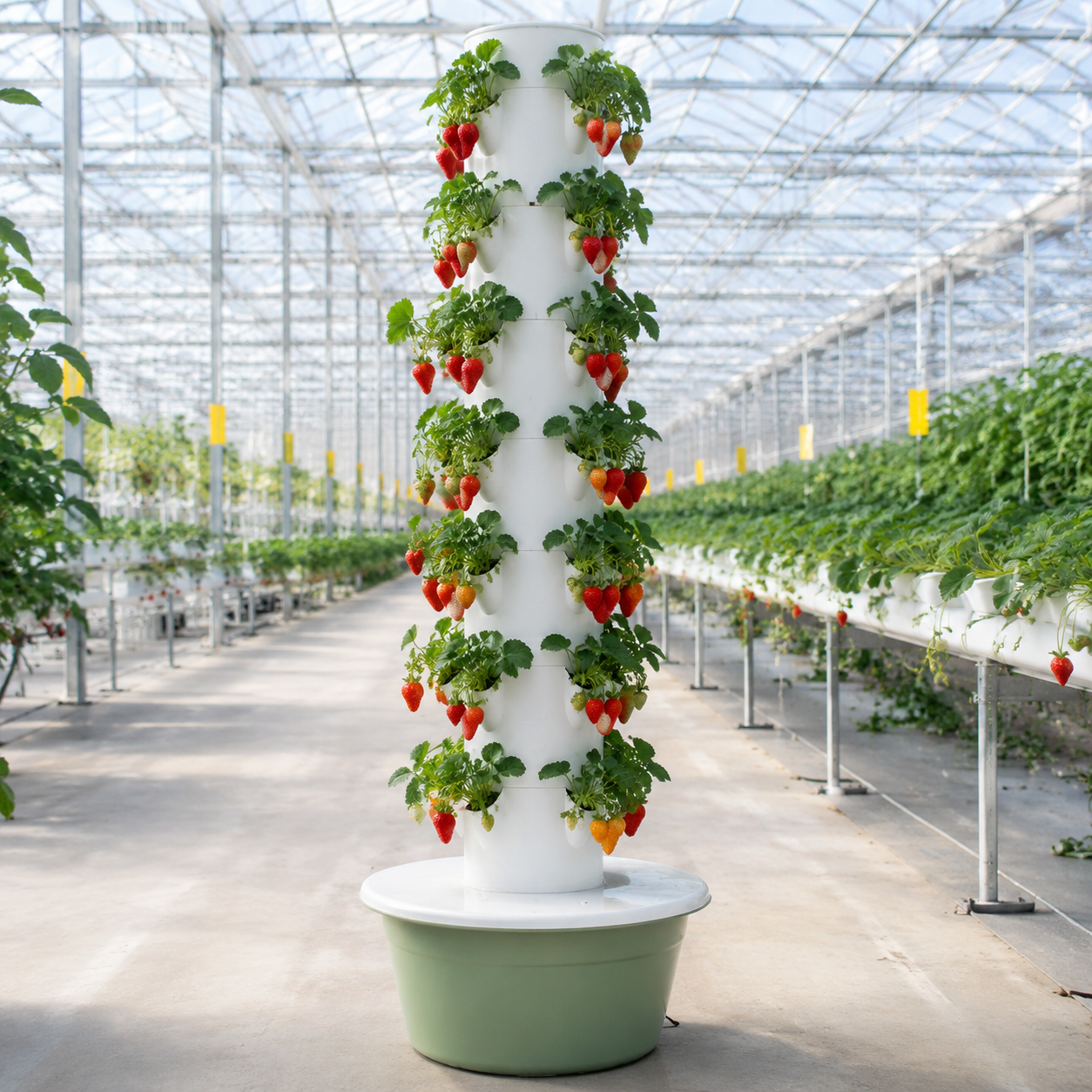
We have documented the full journey — economics, layout, and production data — in our case study of a 100-tower strawberry cultivation project. If you are planning a strawberry tower room, that article walks through the numbers that matter before you order a single tower.
Not every tower is equally suited to strawberries. Fruiting crops need strong light penetration down the column and easy access to every port for daily pollination and harvest. Our factory configures towers for strawberry operations with integrated LED lighting options, wider port spacing for fruiting crops, and reservoir kits sized for the higher water demand of fruiting plants. We also provide crop-specific planting guidance with every wholesale order — including strawberry EC schedules, pollination setup recommendations, and grower checklists — so your first season does not have to be a learning curve paid for in lost berries.
Whether you are starting with 10 towers or planning a 100-tower strawberry room, tell us your setup and we will match the configuration — and the support — to your plan.
