Our Location
304 North Cardinal St.
Dorchester Center, MA 02124

304 North Cardinal St.
Dorchester Center, MA 02124

Every commercial tower buyer asks the same first question: what does a tower cost? It is the natural question and, over five years, it is also the smallest number in the calculation. The purchase order is a one-time event. Pumps, nozzles, seals, float valves, growing media, nutrients, labor, and energy arrive on a schedule, every year, whether the farm is profitable or not.
This guide breaks down the total cost of ownership (TCO) of a commercial tower system over five years, component by component, and shows where a lower purchase price quietly becomes a higher five-year cost. It also gives you the worksheet we use to compare two quotes on the same basis, and the purchase order clauses that protect your running costs for the life of the equipment.
Towers are simple machines, which is exactly why they are maintenance-sensitive. The frame and channels will outlast most of the business plans that bought them — eight to fifteen years of service is normal for a properly specified structure. Everything that makes the system work, on the other hand, wears: pumps, seals, nozzles, valves, and tubing all have defined service lives measured in months or a few years.
That creates a predictable asymmetry between suppliers. A seller can cut the purchase price by using a non-standard nozzle thread, an unlisted pump model, or a thinner seal. The buyer sees a lower quote. Nobody sees the cost until year three, when the crew is hunting for a replacement nozzle in a market where only the original supplier has the fitting — and that supplier is now quoting a premium and a 6-week lead time.
Two towers can differ by 20 percent on purchase price and by 60 percent on five-year cost. The only way to see it is to compare them on the same worksheet.
Across a typical commercial bay, five-year running costs (excluding the initial equipment purchase) break down roughly like this:
| Cost bucket | Share of 5-year running cost | What drives it |
|---|---|---|
| Energy — lighting, pumps, aeration, climate | 45 – 65% | Light hours, local electricity price, pump efficiency, how much lighting runs per layer |
| Labor — maintenance, cleaning, inspection, harvest support | 15 – 25% | Maintenance schedule discipline, nozzle and filter access, spare parts availability |
| Water, nutrients, growing media | 8 – 15% | Crop mix, EC management, media choice (rockwool vs. reusable pebbles), reservoir change frequency |
| Spare parts and consumables | 5 – 10% | Component quality, standardization, whether parts are locally available |
| Unplanned repairs and downtime | 3 – 8% | This is the item that grows fastest on low-price equipment |
Notice that the purchase decision influences four of the five buckets. Component quality changes the spare parts bucket directly and the energy bucket indirectly. Serviceability changes labor. Standardization changes downtime. This is why experienced buyers evaluate a tower as an operating asset, not as a product.
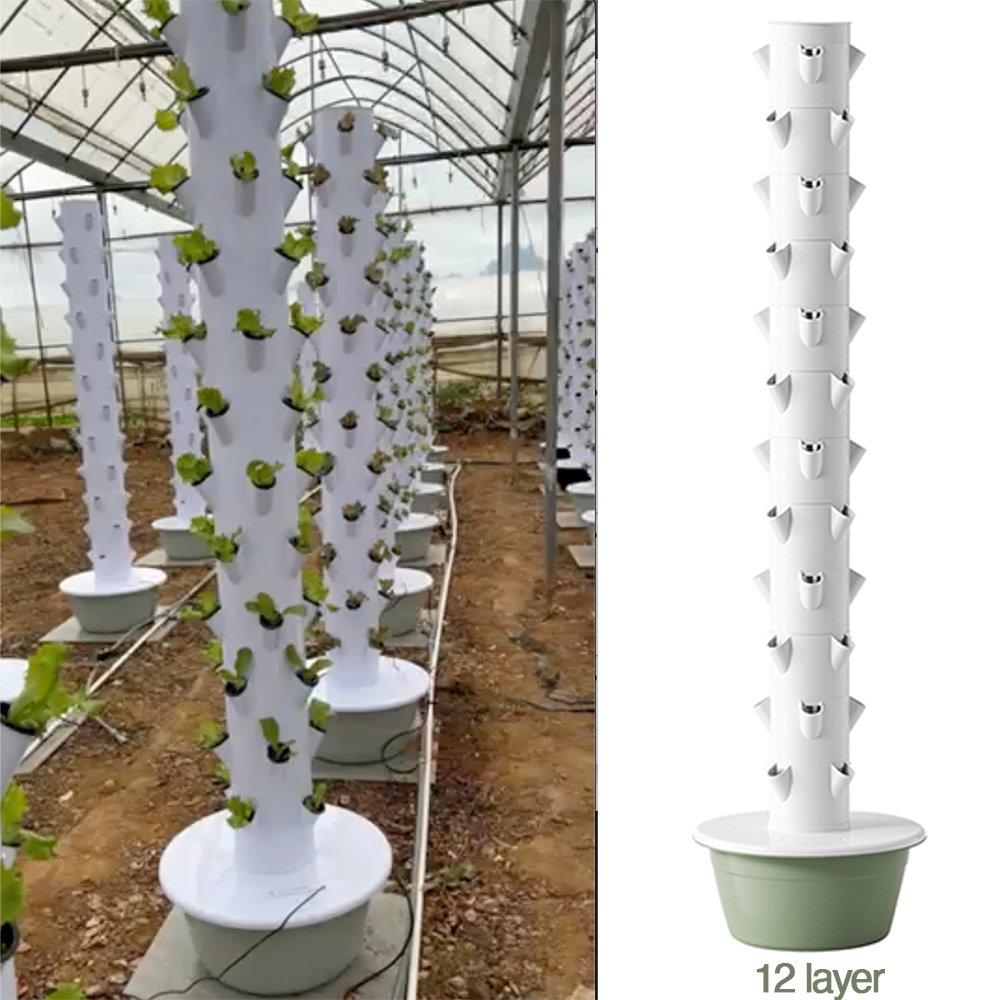
The following covers a 100-tower commercial installation at standard configuration (12 layers, 48 plant sites per tower, roughly 4,800 plant sites total). Energy and labor are expressed as ranges because they depend on your electricity price and labor rate; parts are itemized in the next section.
| Cost category | Year 1 | Years 2 – 3 (annual) | Years 4 – 5 (annual) | 5-year total |
|---|---|---|---|---|
| Equipment purchase (towers, pumps, lights, reservoirs) | deposit / balance | — | — | your quote line |
| Energy | baseline | baseline | baseline + 5-10% | 45-65% of running cost |
| Labor: scheduled maintenance and cleaning | baseline (highest, includes commissioning) | baseline – 10% | baseline – 15% | 15-25% of running cost |
| Water, nutrients, growing media | baseline | baseline | baseline | 8-15% of running cost |
| Spare parts and consumables | low (warranty period) | rising | peak (pump and valve replacements) | $20,000 – $48,000 per 100 towers |
| Unplanned repairs and downtime | very low | low | moderate | $6,000 – $20,000 per 100 towers |
The shape of that table is the important part. Purchasing costs are concentrated in year one and stop. Maintenance and parts costs start near zero under warranty and peak in years three to five, precisely when a farm’s cash flow is being asked to fund expansion. Buyers who model only year one are always surprised by year three.
These are the working numbers we use for planning purposes. Service lives assume clean water, correct filtration, and a scheduled maintenance routine — the same components last far shorter in an unfiltered system.
| Component | Typical service life | Unit cost | 5-year cost per 100 towers |
|---|---|---|---|
| Circulation pump (one per tower) | 2 – 4 years | $90 – $180 | $9,000 – $18,000 (one full replacement cycle) |
| Air pump / aeration unit | 2 – 4 years | $40 – $90 | $4,000 – $9,000 |
| Spray nozzles / emitters (4 per tower) | 12 – 24 months | $0.60 – $1.50 | $1,200 – $3,000 (annual refresh) |
| Seals, O-rings, gaskets | 1 – 2 years | $5 – $15 per tower kit | $1,000 – $3,000 |
| Float valves (reservoir level control) | 3 – 5 years | $6 – $15 | $600 – $1,500 |
| Net pots / plant site inserts | 3 – 5 years (reusable types) | $0.15 – $0.50 | $2,000 – $7,000 |
| Tubing, connectors, grommets | 2 – 4 years | $0.20 – $2.00 | $1,500 – $4,000 |
| Reservoir tanks (30 L class base) | 5+ years | $25 – $60 | $500 – $1,200 (partial replacement) |
| Frame and channels | 8 – 15 years | — | normally no replacement within 5 years |
Total spare parts and consumables over five years for 100 towers: roughly $20,000 to $48,000, or about $200 to $480 per tower. That range is not driven by the towers — it is driven by whether the parts are standard, whether they are documented, and whether the supplier can ship them without a production run. For reference, see how all of these components fit together in our daily, weekly, and monthly maintenance checklist.
Low purchase prices are not automatically bad equipment — they are often the result of a leaner supply chain, and factory-direct pricing is genuinely lower than distributor pricing for identical hardware. The trap is narrower and more specific. It is when a low price is achieved by making the system harder to own. The warning signs are consistent:
The cost of that trap is not mainly the parts. It is the downtime. A single tower’s cycle is worth roughly $120 to $160 in forgone revenue at basil pricing (48 plant sites at $2.50 to $3.30 per site per cut). A two-week wait for a $120 pump that shuts down a block of ten towers costs several times the pump — and that is before counting the crop you have to replant because the roots dried out.
This is the practical case for buying from the manufacturer. When you purchase factory-direct, the spare parts relationship survives the sale: the same people who built the tower hold the BOM, stock the wear items, and can ship a documented kit with your container or after it. That is the single largest controllable variable in your five-year cost.
Ask both suppliers for the same eight items. Most quotes collapse under this comparison because one side simply cannot produce them.
| Ask for | Why it changes the five-year cost |
|---|---|
| Full bill of materials with part numbers and sizes | Lets you price wear items anywhere in the world instead of only from the seller |
| Nozzle and fitting specifications (thread type, orifice size) | Standard sizes mean local sourcing; proprietary sizes mean captive pricing |
| Pump model, rated head, and rated hours | Determines pump life and the energy bucket, which is the largest cost category |
| Spare parts kit contents shipped with the order | Turns the first year of failures into maintenance instead of downtime |
| Documented service intervals for each wear item | Converts maintenance from reactive to scheduled, which cuts labor and downtime |
| Warranty terms for pumps, controls, and structure separately | Almost always different lengths; a single warranty number usually hides the weak link |
| Spare parts price list with validity period | The only way to forecast year 3 to 5 costs before you sign |
| Packing list and container loading plan | Freight per plant site is a real five-year cost when you expand |
Run these against the quote you would actually sign. If a supplier cannot produce a spare parts price list before the order, the phrase "spare parts available" in their marketing has no operational meaning. Our own approach is to ship a documented kit with every order — nozzles, seals and O-rings, float valves, connectors — and to keep the BOM on file so a customer can order any wear item years later without a new tooling run. This is also the difference between buying a tower and buying a tower supply relationship, which we covered in our manufacturer sourcing guide.
None of these clauses cost money to ask for. They cost a supplier something only if they cannot deliver them.
Equipment choice sets the floor on TCO; operations set the ceiling. Four habits consistently move the number the most:
The frame and channels should serve eight to fifteen years with normal maintenance. Expect to replace circulation pumps and aeration units once or twice in that period, nozzles annually or biennially, and seals and O-rings every one to two years. Planning those replacements as a scheduled budget line rather than a surprise is the practical meaning of total cost of ownership.
No — factory-direct pricing from a real manufacturer is genuinely lower than distributor pricing for equivalent hardware, and that is a legitimate saving. The false economy is when a low price is achieved through non-standard parts, missing documentation, or no spare parts support. The test is not price, it is whether you can source every wear item and service the system yourself five years from now.
In most commercial indoor installations the initial equipment purchase lands somewhere between 25 and 45 percent of the five-year total, with energy being the single largest running cost and spare parts and downtime typically accounting for $26,000 to $68,000 per 100 towers. The exact split depends heavily on electricity price and light hours.
A workable rule is $200 to $480 per tower over five years, front-loaded with a documented starter kit at commissioning and then held as an on-site inventory of one pump, one aeration unit, and 20 nozzles per bay. For how this fits into the wider capital plan, see our tower cost and ROI breakdown and 100-tower farm scale-up guide.
