Our Location
304 North Cardinal St.
Dorchester Center, MA 02124

304 North Cardinal St.
Dorchester Center, MA 02124

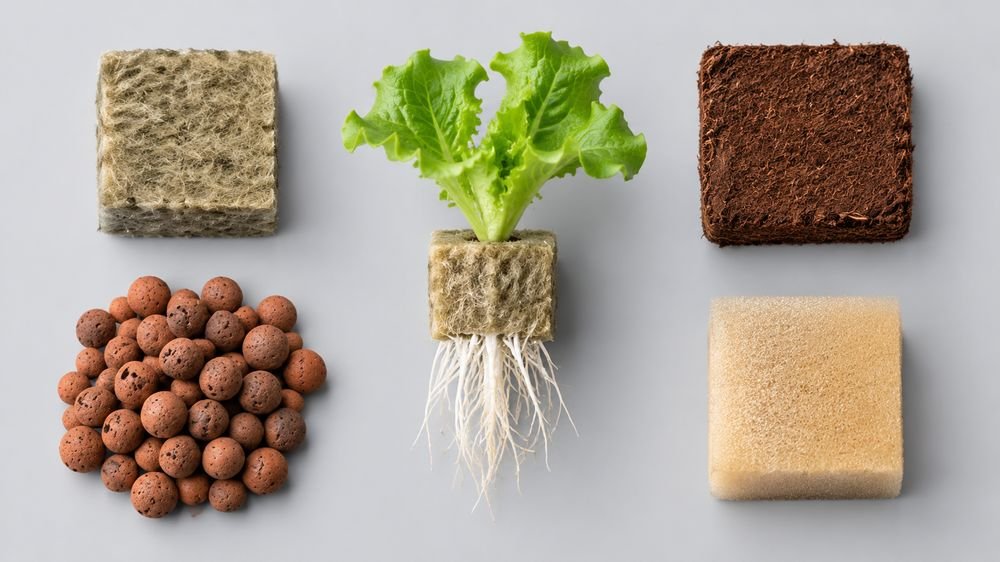
Ask ten commercial growers which pump, EC setpoint, and light schedule they run and you will get ten confident answers. Ask them what growing medium goes into the tower — and why they chose it — and most will shrug. In vertical tower systems the medium is the least examined input and one of the most expensive to get wrong: it controls oxygen at the root zone, how much moisture a plant has between irrigation cycles, how fast pH drifts through the channel, and how much you spend on consumables every single crop.
This guide compares the four media that actually matter in commercial tower production — rockwool (stone wool), coco coir, expanded clay pebbles, and peat or phenolic foam starter cubes such as Oasis cubes. You will get side-by-side performance data, a cost-per-plant math model for a 100-tower operation, a crop-by-crop recommendation matrix, and the handling mistakes that turn a cheap medium into a lost crop.
In a raft or a nutrient film channel, the medium is little more than an anchor. Roots spread through a large, well-aerated volume of moving water, and the medium’s water-holding behavior barely registers. A vertical tower is the opposite geometry. Roots are packed into a narrow column, water passes each root zone for seconds rather than continuously, and the same channel is shared by 40-plus plants on a single tower. That is why tower systems behave so differently from NFT and DWC.
In that geometry, the medium becomes the root-zone environment itself. It decides five things:
Here is the comparison most supply catalogs never give you: performance characteristics side by side with the numbers that matter for a tower, not a field or a pot.
| Medium | Water Retention | Air Porosity (Oxygen) | Effect on pH | Reusable? | Cost per Plant / Cycle | Best Fit in a Tower |
|---|---|---|---|---|---|---|
| Rockwool (stone wool) cubes | Very high (~75–80%) | Moderate (~15–20%) | Starts alkaline (pH 7–8); must be pre-soaked to pH 5.5 | No — one cycle only | $0.04–$0.08 | Lettuce, leafy greens, herbs in 1.5"–2" cubes — the industry default |
| Coco coir | High (~65–75%) | Good (~20–30%) | Naturally high in potassium and sodium; binds calcium and magnesium, so it needs buffering | Sometimes — one extra cycle if sterilized | $0.02–$0.05 plus buffer cost | Larger crops, plugs, and blends; needs careful drainage in a vertical channel |
| Expanded clay pebbles | Low (~15–20%) | Very high (40%+) | Inert and near-neutral once rinsed | Yes — 10–15+ cycles | $0.07–$0.12 upfront; about $0.005 amortized | Physical support for tomatoes, peppers, and strawberries; heavy drinkers |
| Peat / phenolic foam cubes (Oasis) | High (~70%) | Moderate (~20%) | Slightly acidic to neutral | No | $0.03–$0.06 | Fast, low-cost propagation for short-cycle greens and microgreens |
The single most underrated number in that table is the last one. Growers compare media on the purchase price printed on the pallet; the decision that actually moves your cost per head of lettuce is the cost per plant, per cycle, multiplied by the number of cycles you run in a year.
Rockwool dominates commercial lettuce and herb propagation for one reason: uniformity. Every cube is identical in fiber density and water-holding behavior, so a 4,800-site planting behaves like one plant repeated 4,800 times. That predictability is worth real money when you are scheduling harvests and balancing EC across a farm.
What you have to get right with rockwool:
Its weakness is disposal. Spent rockwool is bulky, slow to break down, and increasingly regulated in parts of the EU. Plan for the volume in your waste stream before you commit to it at scale, and factor it into your per-tower operating cost model.
Coco coir gives you something rockwool cannot: a medium with genuine cation exchange capacity, meaning it holds and releases nutrients instead of just holding water. Roots look noticeably better in coir when the crop runs longer than 40 days.
But coir has three habits that catch tower growers out:
Used well, coir suits larger fruiting crops and blended plugs. Used carelessly, it is the medium most likely to clog your tower.
Expanded clay pebbles (sold as LECA or hydroton) are fired clay: chemically inert, pH-neutral after rinsing, and reusable for a decade or more. If you run six cycles a year, one purchase of pebbles can carry 60-plus crops. Nothing else in this comparison comes close on lifetime cost.
Pebbles are the right answer for tomatoes and other vining crops and for strawberry production, where crowns need support and drainage more than they need moisture buffering.
Oasis-style foam cubes and compressed peat plugs are the lowest-cost way to start a plant. Roots penetrate them quickly, they hold moisture well, and they are light enough that a whole season of propagation ships in a single carton. For baby leaf and microgreen production on three-week cycles, they are frequently the economically correct choice.
To make this concrete, model a mid-size commercial operation: 100 towers at 48 planting sites each, running six crop cycles per year — 28,800 plants a year. Site counts and layouts are covered in detail in our tower plant capacity guide.
| Medium | Cost per Plant, per Cycle | Annual Media Spend | 3-Year Media Cost |
|---|---|---|---|
| Rockwool cubes | $0.055 | $1,584 | $4,752 |
| Peat / foam starter cubes | $0.045 | $1,296 | $3,888 |
| Coco coir (buffered) | $0.030 | $864 | $2,592 |
| Expanded clay pebbles | $0.005 (amortized one-time fill of $0.09 per site) | $144 | $432 |
The spread between the most expensive and least expensive practice is more than $4,300 across three years — roughly the cost of a complete nutrient dosing system, or a second greenhouse bay. Media is a procurement decision, not an afterthought folded into the consumables budget.
Two caveats before you switch everything to pebbles to chase that number:
If you want the wider picture — towers, pumps, dosing, and payback — start with hydroponic tower cost breakdown and ROI timeline.
| Crop | Recommended Medium | Why | Notes |
|---|---|---|---|
| Lettuce and leafy greens (28–45 day cycles) | Rockwool 1.5" cube or foam cube in a 2" net pot | Uniform germination and predictable moisture over a short cycle | Single-use media are easy to justify when the cycle is this short. See leafy green cultivation |
| Basil and culinary herbs | Rockwool cube or coco plug | Herbs tolerate higher EC and grow fast in a stable cube | Full guide: basil and high-value herb production |
| Strawberries | Clay pebbles plus a rockwool starter cube | Crowns must stay dry; pebbles give drainage and crown support | See strawberry production guide |
| Tomatoes, peppers, cucumbers | Clay pebbles in a 3"–4" net pot | Heavy plants need physical anchoring and high water throughput | See growing vining crops in towers |
| Kale, chard, collards | Rockwool cube or coco plug | Longer cycle and larger root mass than lettuce | Coco holds up well past 40 days |
| Microgreens and baby leaf | Peat or foam cubes, or shallow trays | Cheapest per plant; the cycle is too short to justify durable media | Maximize turnover, not medium durability |
Before you order a container load of any medium, confirm three mechanical details on your tower specification. Getting these wrong is expensive in a way no cost spreadsheet captures.
For a full planting sequence with propagation timing, see our seed-to-harvest planting guide and seedling transplant walkthrough.
Reservoir discipline and medium choice work together. If you are still dialing in your water changes, start with how often to change water in a tower.
No. Soil in a recirculating vertical system compacts into the channel, blocks drainage, introduces soil-borne pathogens, and consumes the oxygen your roots need. Every medium in this comparison is inert or sterile and engineered to drain.
In commercial food production, yes. Reused stone wool holds root debris and pathogen inoculum, and it loses structural integrity as fibers break down. The cost per plant is low enough that reuse is a false economy.
Not universally. Coir buffers nutrients better and suits longer cycles; rockwool is more uniform, easier to automate, and simpler in a small tower port. The deciding factors are your crop duration, your ability to buffer and rinse coir properly, and whether fine particles can migrate in your channel geometry.
If you run multiple cycles per year and grow crops that need support, yes. Amortized over ten or more cycles, pebbles cost a fraction of a cent per plant per cycle, and they carry no disposal liability. The trade-offs are weight, freight cost, and the need to sterilize between crops.
Expanded clay pebbles on a per-cycle basis, once amortized. On a first-purchase basis, peat or foam starter cubes are the cheapest — which is why they dominate short-cycle baby leaf and microgreen production.
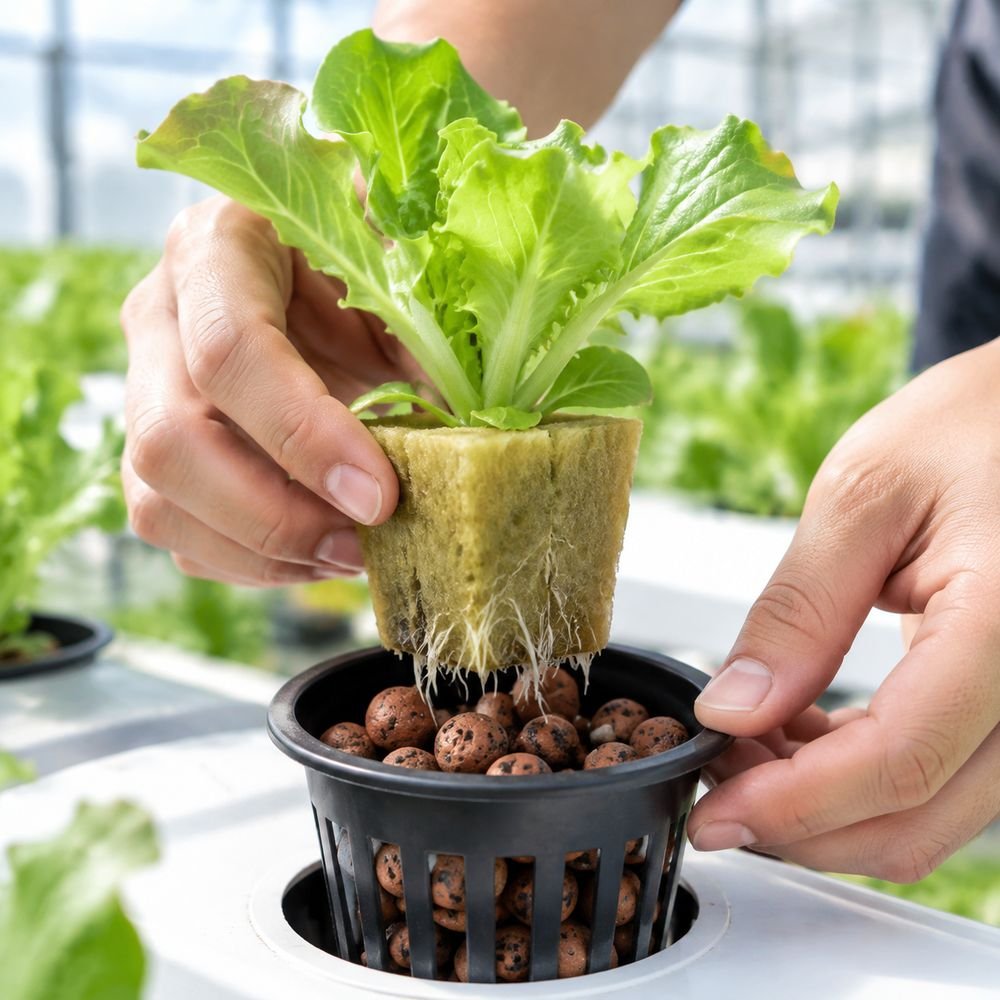
Yes, and most commercial operations do. The standard combination is a rockwool or foam starter cube nested in a net pot filled with expanded clay pebbles: the cube provides moisture buffering for the seedling, and the pebbles provide drainage and physical support for the mature plant.
Calculate from the port count, not the tower footprint. A 12-layer tower typically carries 48 planting sites, so one tower needs 48 cubes and 48 net pots — or 48 cubes plus roughly 4 liters of pebbles. A standard 2-inch net pot holds about 0.08 liters of pebble fill, which means a 50-liter bag covers several hundred pots.
The medium decision is downstream of tower geometry. Confirm port diameter, net pot compatibility, and channel drainage first — then pick the medium that fits your crop cycle and your labor model. Structures built around standard, non-proprietary net pot sizing keep your medium options open, which matters more every year as substrate prices and disposal rules move.
Tell us your crop, cycle length, site count, and climate, and we will size a system and recommend a medium strategy with the per-cycle cost laid out.
