Our Location
304 North Cardinal St.
Dorchester Center, MA 02124

304 North Cardinal St.
Dorchester Center, MA 02124

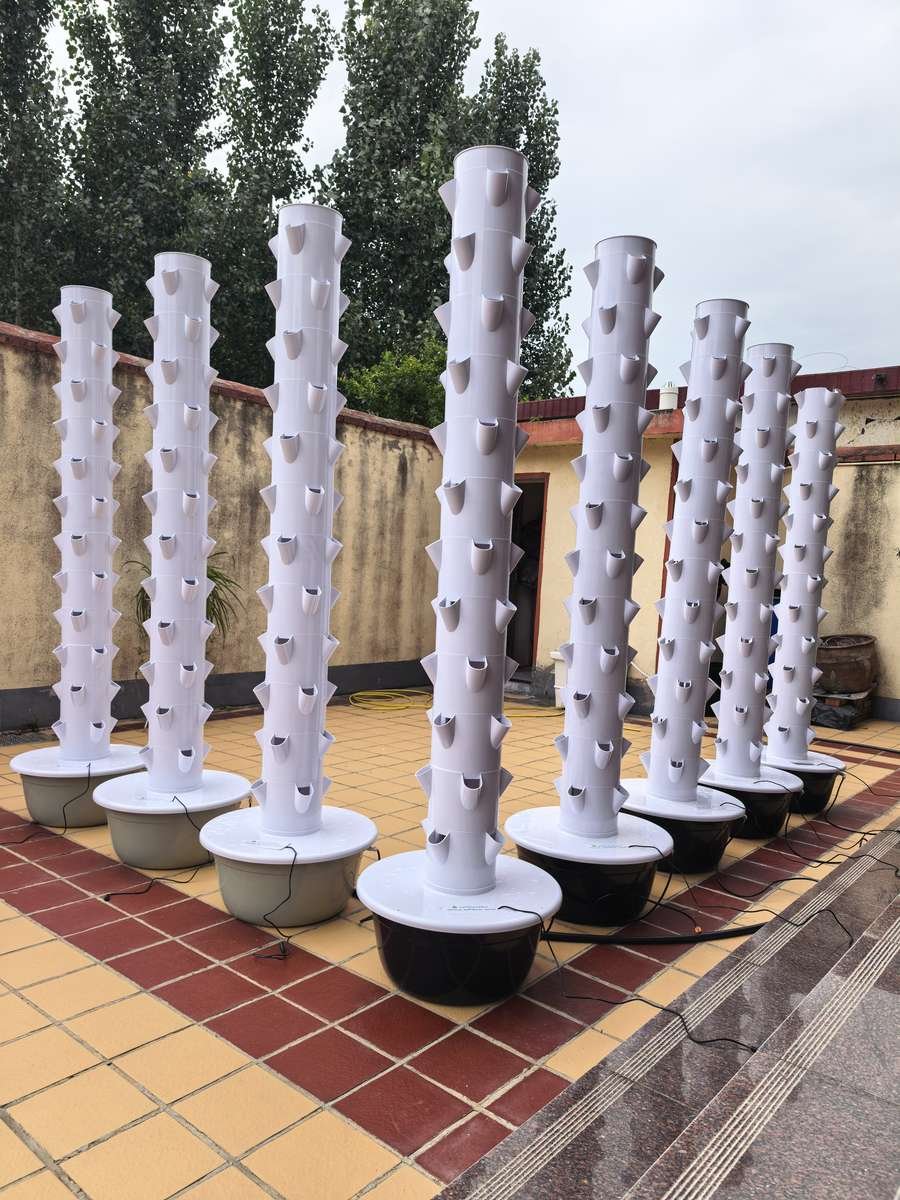
Ask an experienced tower grower what actually causes most crop losses and the answer is rarely nutrition. It is water timing. A pump that runs too few cycles lets the root zone dry at the top of the stack and stay waterlogged at the bottom. A pump that runs constantly keeps roots submerged, starves them of oxygen, and grows algae in every channel it touches. A partially clogged nozzle delivers full flow to six layers and almost nothing to three, and the first visible sign is a yellow middle layer three weeks later. By the time the crop shows symptoms, the mistake was made four weeks earlier on a timer screen nobody looked at.
This guide covers the operating layer that most tower documentation skips: how many irrigation cycles per day, how long each cycle should run, what the target flow rate per tower is and how to measure it in one minute with a measuring cup, how to verify that every layer is being fed evenly, how to program a timer for heat waves and cold snaps, and how to diagnose the six causes of nozzle clogging before they cost you a cycle. It is written for operators running 6, 9, and 12-layer commercial towers, and every number below is a starting point to be verified against your own system – not a setting to copy blind.
A tower is a gravity-fed system. A small pump in the reservoir pushes water to the top of the stack, where an internal distribution nozzle spreads it across the growing channel. Water then films down through each layer under gravity, feeding every planting site it passes, and drains back to the reservoir. Three variables decide whether the system works: pump head, cycle duration, and uniformity from the top layer to the bottom layer.
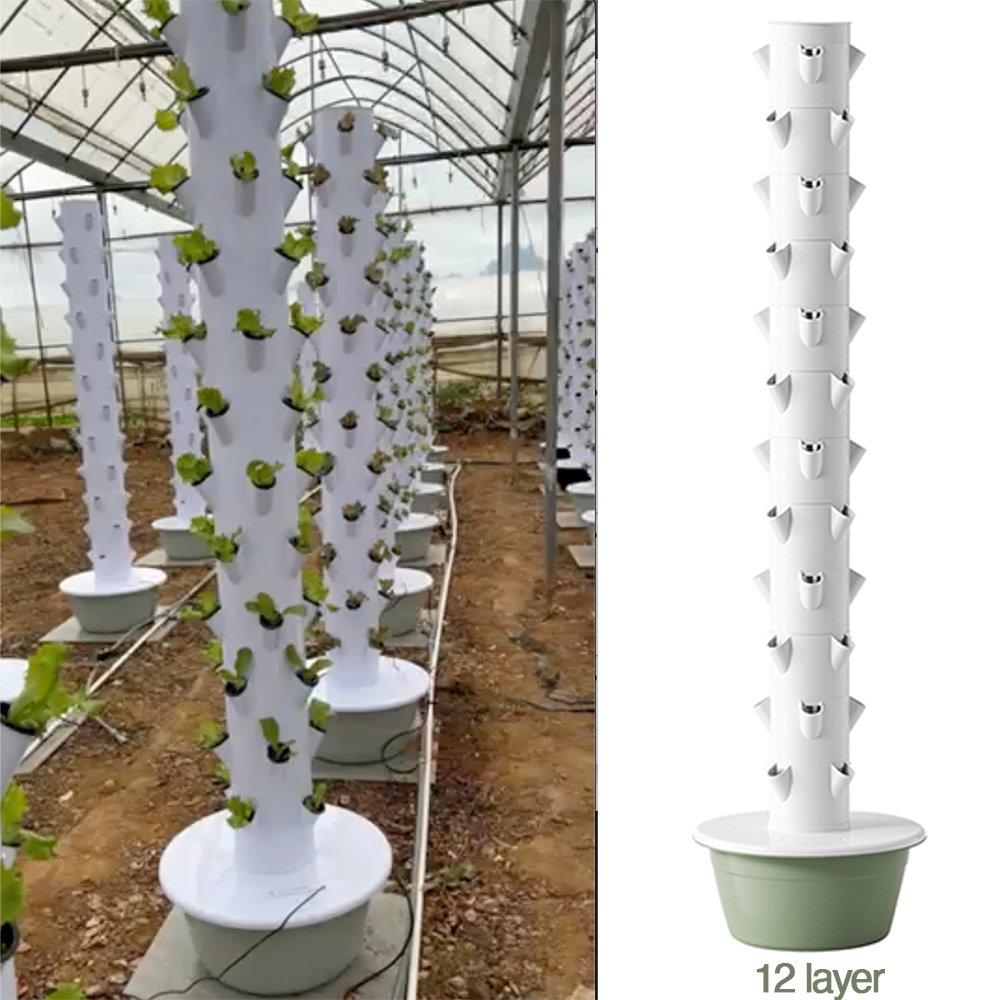
Pump head is the number most operators get wrong, because pump marketing is written in liters per hour at zero head. A pump rated 2,000 L/h at zero lift may deliver a fraction of that once it has to lift water 2.3 m to the top of a 12-layer tower. Always size to the head you need, then check the flow you actually get with a stopwatch and a container.
| Tower model | Planting sites | Tower height | Required pump head | Target flow at the top nozzle | Standard reservoir |
|---|---|---|---|---|---|
| 6-layer | 24 | ~105 cm / 3.4 ft | ~1.2 m / 4 ft | 2-4 L/min (0.5-1.0 gpm) | 20-30 L |
| 9-layer | 36 | ~157 cm / 5.2 ft | ~1.8 m / 6 ft | 3-5 L/min (0.8-1.3 gpm) | 25-30 L |
| 12-layer | 48 | ~207 cm / 6.8 ft | ~2.3 m / 7.5 ft | 3-6 L/min (0.8-1.6 gpm) | 30 L (standard base tank) |
Translated to the plant level, a 12-layer tower at 48 sites receiving 4 L/min is delivering roughly 83 mL per site per minute while the pump is running. That is enough to keep a nutrient film moving across every root zone and to carry oxygen with it. Below about 3 L/min, the lower two or three layers start to see intermittent film – wet, then dry, then wet – which is the pattern that produces uneven growth and pythium pressure at the same time.
The industry default for tower systems is short, frequent pulses rather than long flood events. Short pulses keep the root zone moist without drowning it, keep dissolved oxygen high, and reduce the volume of water moving through the system each day. The schedule below is a baseline for a mature crop in average conditions – 20-24 C, moderate humidity, plants that fill their sites.
| Tower model | Cycles per day (lights on) | Minutes per cycle | Night cycles | Duty cycle |
|---|---|---|---|---|
| 6-layer | 8-12 | 2-3 | 2-3 | ~5% |
| 9-layer | 12-18 | 3-4 | 3-4 | ~7% |
| 12-layer | 15-24 | 3-5 | 4-6 | ~8-12% |
Read the duty cycle column as the percentage of each day the pump is actually running. Anything above about 20% is usually a symptom of a different problem – a clogged nozzle forcing longer run times, or a media choice that drains poorly – rather than a deliberate setting. Continuous circulation is a common mistake in new installations: it feels safe because the plants never dry out, but it removes the air exchange that root zones need, drives pump wear, and warms the reservoir faster than the room can cool. If you want continuous flow, you want aeroponics or NFT, not a tower. The trade-offs are compared in tower vs NFT vs DWC.
Every commercial tower room should be calibrated, not guessed. The test takes one minute per tower and tells you whether the pump is delivering what the design assumes, whether flow is declining over time, and whether two towers on the same manifold are behaving identically.
Two additional readings make the test far more useful. First, measure conductivity or EC at the top layer and at the bottom layer 10 minutes into a cycle; a large gap means the upper layers are stripping nutrients faster than the flow is replenishing them. Second, take the temperature of the nutrient solution at the reservoir and at the return line of the furthest tower. If return water arrives noticeably warmer, the room is heating the solution in the channels, and you should shift more of the irrigation into the coolest hours.
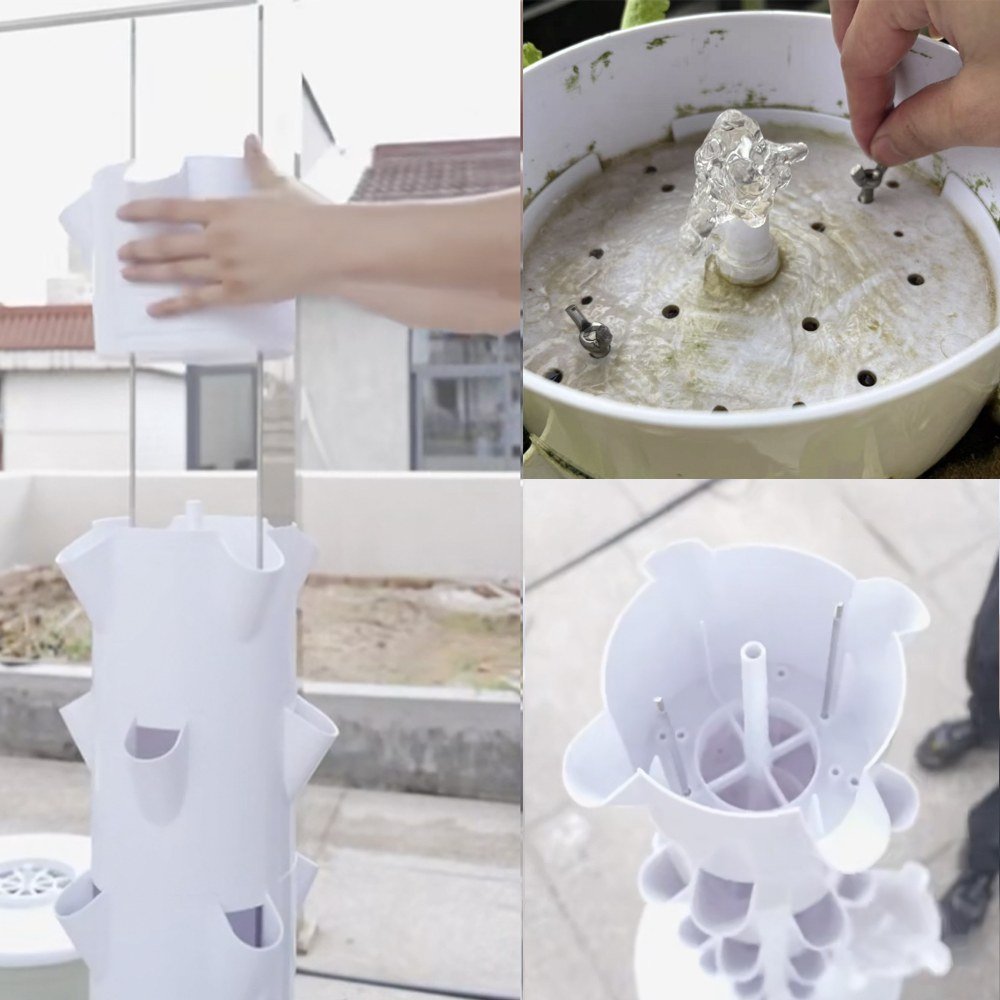
Uniformity is the difference between a room that looks uniform at harvest and a room where one column is two weeks behind. Water films thin out as they descend, so the bottom layers of a tall tower are always the first place a flow problem shows up. Build a habit of checking three positions in every tower: the top layer, the middle layer, and the bottom layer, at the end of a cycle rather than during it.
| Symptom | Where it shows first | Likely cause | Action |
|---|---|---|---|
| Dry media in top 1-2 layers | Top of the stack | Head too low, nozzle misaligned, or cycle too short | Check flow at top nozzle; extend cycle by 1 minute |
| Bottom layers wet or stagnant | Bottom 2-3 layers | Return drain restricted, roots in the channel, or continuous run time | Clear drain, shorten cycles, add a dry-down period |
| Uneven growth column to column | One or two towers in a row | Manifold pressure drop, kinked feed line, partial nozzle block | Inspect feed line, run the one-minute test on both towers |
| Yellow middle layer only | Middle layers | Film breaking on the way down as roots thicken | Increase cycle frequency rather than duration |
| Algae film on channels | Exposed channel surfaces | Light ingress plus long wet periods | Block light, reduce run time, review nutrient temperature |
| White mineral crust at nozzle | Nozzle and top layer | Hard water scale | Descale nozzle monthly; review source water alkalinity |
This is also why the phrase “set it and forget it” has no place in a tower room. Growing roots progressively restrict the flow path over each crop cycle, so the schedule that was correct at day five is not necessarily correct at day thirty. Re-run the one-minute test at transplant, at mid-cycle, and before harvest, and adjust as the canopy fills. Related causes of decline are covered in our troubleshooting guide.
Most commercial tower installations use a programmable repeating-cycle timer or a controller with pulse-width scheduling. The exact menus differ, but the decisions are always the same five.
Two failure patterns to design around. The first is a power interruption: a timer without a battery backup loses its program after an outage, and a room that goes five hours without irrigation in warm weather can lose a crop. The second is alarm silence. Any commercial controller should flag a pump that runs continuously, a cycle that never starts, or a reservoir that drops faster than the room’s normal daily consumption. If your controller cannot alarm, at minimum add a float switch on the reservoir and a daily visual check. Both are covered in the daily, weekly, and monthly maintenance checklist.
The distribution nozzle is the single most failure-prone component in the system, and it fails slowly. A nozzle that loses 30% of its flow does not announce itself; it quietly starves the top layers until the crop tells you. Treat nozzle inspection as a scheduled task, not a reaction.
| Cause | Symptom | Fix / prevention |
|---|---|---|
| Mineral scale from hard water | White crust; gradual flow loss over weeks | Monthly descale in a mild acid solution; monitor source alkalinity |
| Algae and biofilm | Slimy film; green tint in the channel | Block light from the reservoir and channels; short dry-down periods between cycles |
| Root fragments and media dust | Sudden partial blockage after transplanting | Rinse media before planting; add a coarse pre-filter on the return line |
| Nutrient precipitate | Cloudy solution; chalky deposits in the reservoir | Keep tank concentration within range; do not pre-mix calcium and sulfate concentrates |
| Improper nozzle angle | One side of the channel wet, the other dry | Re-seat the nozzle after service; verify spray pattern visually each change-out |
| Insufficient pump head or impeller wear | Low flow everywhere, not just one nozzle | Check flow with the one-minute test; replace impellers or pumps on the published cycle |
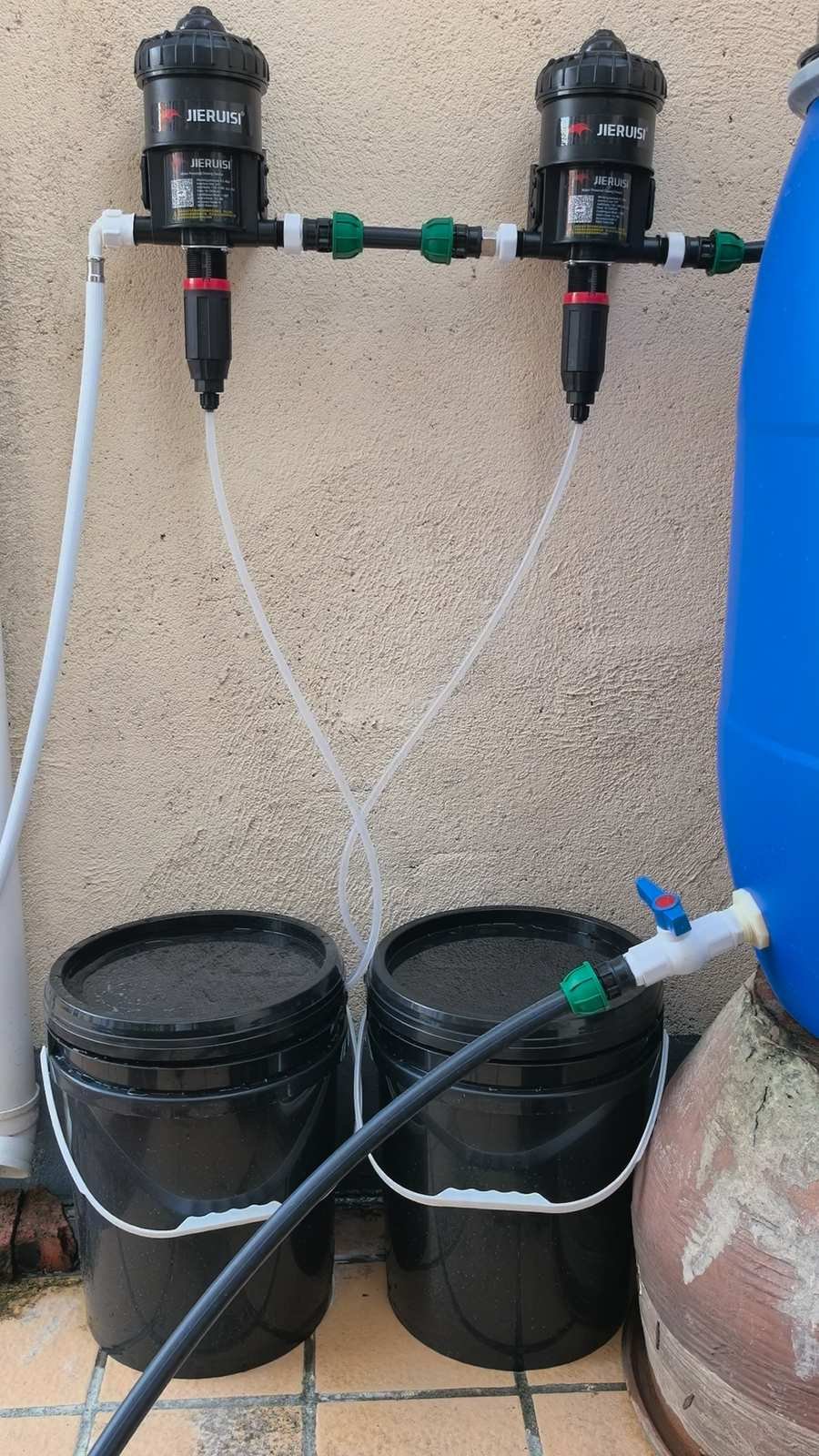
A simple, inexpensive habit prevents most of this: designate one spare nozzle per tower row and swap nozzles on a rotating schedule at every crop turn, cleaning the removed set offline while the system keeps running. Rotating nozzles costs almost nothing and removes the single largest source of unplanned downtime in tower rooms. Spares pricing and replacement intervals are broken out in our five-year cost of ownership analysis.
| Condition | Adjustment | Watch for |
|---|---|---|
| Heat wave (above 30 C daytime) | Add mid-day cycles; shorten duration; run more night cycles | Reservoir temperature climbing above 24 C |
| Winter / cold room (below 18 C) | Reduce night cycles; keep day cycles unchanged | Over-wet media and slow root-zone drying |
| High humidity / low VPD | Keep cycles short; extend dry-down periods | Biofilm on channels and slow transpiration |
| Fruiting or flowering stage | Increase frequency as canopy water demand rises | Middle-layer film breaking under heavy roots |
| Fresh transplant week | Reduce cycle length; increase frequency | Media staying saturated around new plugs |
| Dense canopy late in cycle | Expect 10-20% more cycles than at day five | Bottom-layer stagnation as roots fill the channel |
The pattern behind the table: irrigation responds to three inputs – root volume, air temperature, and humidity. When any one of them rises, frequency rises. Duration changes only when you switch crop type, media, or tower model. Operators who understand that rule rarely have to relearn their setpoints each season. Water quality itself – alkalinity, sodium, and chlorine levels – sets the ceiling on how tolerant a system is to long cycle intervals, which is why source water testing belongs in the same conversation as pump settings.
No. Continuous circulation starves roots of oxygen, warms the solution, increases power use, and encourages algae. Run short, frequent pulses through the photoperiod, then a reduced night schedule – typically four to six short cycles for a 12-layer stack. The correct target is moist roots with visible air exchange between cycles, not permanently submerged ones.
As a working range: 2-4 L/min for a 6-layer tower, 3-5 L/min for 9-layer, and 3-6 L/min for a 12-layer tower measured at the top distribution point. What matters more than the exact figure is that the flow is measured, recorded, and stable over time, and that every tower on the manifold reads within about 20% of the others.
Two likely causes: insufficient pump head, so the top nozzle receives a weak spray, or cycles that are too short for water to travel the full height of the stack and saturate the upper media. Measure flow at the top nozzle first, then lengthen the cycle by one minute and observe for 48 hours before changing anything else.
Descale and inspect monthly in hard-water areas, and rotate one spare nozzle per row at every crop turn. Plan on replacing nozzles every 12-24 months depending on water quality and how aggressively you run sanitizing agents. Seals and O-rings typically last one to two years, and pumps two to four years – keep all three on a parts shelf.
Tower hydraulics are set at the factory as much as in your room: layer count determines lift, internal channel geometry determines how uniformly the film is distributed, and nozzle bore determines the flow you need. We manufacture commercial towers with customizable layer counts and hole density, and we ship each container with the pump curve, the recommended cycle baseline for the model, spare nozzles and seals, and a start-up procedure your operators can follow from day one. If you are troubleshooting an existing room or specifying a new one, send us your tower model, layer count, and current flow readings and we will help you set the schedule. Start with scaling up to a 100-tower farm to plan manifold sizing and pump selection at volume.
